
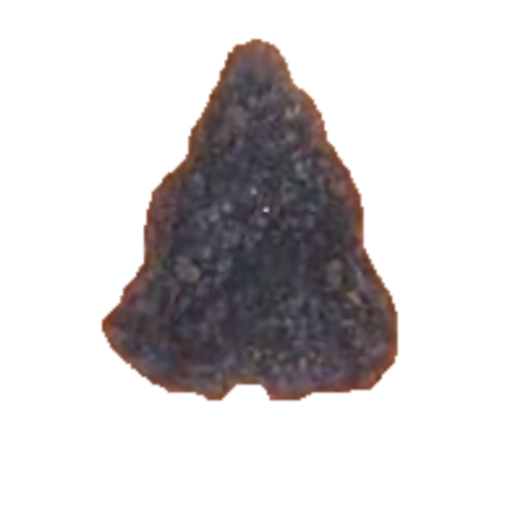
Arrowhead type
Brewerton Eared Triangle Point
Brewerton Eared TriangleMatanzas Cluster5,000 - 4,000 B.P.Middle Archaic3 reference photos
Key facts
- Age
- 5,000 - 4,000 B.P.
- Cultural period
- Middle Archaic
- Culture
- Brewerton Culture
- Size
- Small to Medium
- Shape
- Side Notch to Triangle
- Material
- Jasper
- Glacial period
- Middle Holocene to Neoglacial
More from the Archaic period
Description
This triangular side notch point exhibits a compact to medium size and an elliptical profile. Its blade curvature is predominantly excurvate, although some specimens may display a straight configuration. The side notches are characterized by their shallow depth and parallel alignment. When a stem is present, it tends to expand outward. The basal edge is typically straight and may feature evidence of basal grinding. As a variant of the Brewerton Eared point, this type is distinguished by its generally wider and thinner proportions, coupled with relatively shallow notches. The flaking pattern observed on this point is random, lacking a discernible pattern or orientation.
Size
The dimensions of the arrowheads are as follows: they typically range in length from 27 to 60 mm, with an average length of 27 to 38 mm. The stem length varies between 6 to 9 mm, averaging 7 mm. In terms of width, the blade measures between 14 to 24 mm, with a mean width of 16 mm, while the stem width ranges from 16 to 26 mm, averaging 18 mm. The thickness of the arrowheads is consistently between 5 to 6 mm.
Distribution
The Brewerton Complex points are mainly located in the northeast region and extend into the Ohio River basin. They have also been identified in the Tennessee River Valley and middle to southern Mississippi River valley, albeit less commonly
Mainly found in
Also found, less often, in
Additional information
The Brewerton Complex is a notable archaeological phenomenon, and one of its most elusive artifacts is a specific type of projectile point. This distinctive point is predominantly discovered in the northeastern United States, with a significant presence also observed in the Ohio River Valley. Notably, its distribution is relatively limited, with few examples found outside of these regions. The restricted geographic range of this point underscores its cultural and historical significance, providing valuable insights into the migration patterns, trade networks, and technological developments of the indigenous populations that created and utilized these artifacts.
The northeastern states and the Ohio River Valley, where this point is most commonly found, were likely key areas of cultural exchange and interaction among Native American groups. The presence of this specific point in these regions suggests a complex web of relationships and influences, which would have shaped the technological, social, and economic dynamics of these communities. Further research into the distribution and characteristics of this point may shed light on the specific cultural associations and historical contexts in which it was produced and used.
The relative rarity of this point outside of its primary areas of discovery highlights the importance of continued archaeological investigation and documentation. By examining the distribution, morphology, and cultural context of this artifact, researchers can gain a deeper understanding of the historical and cultural landscape of Native American communities in the northeastern United States and the Ohio River Valley. This, in turn, can inform our appreciation of the complex and nuanced history of human presence in these regions, and the significant contributions of indigenous cultures to the rich cultural heritage of North America.
Identified by
- Named by
- William Richie
- Year
- 1961
- Type site
- Robinson Site, Onondaga County, New York
Similar types
Types that are easy to confuse with the Brewerton Eared Triangle point.
- Autauga
- Kittatinny
- Rowan
- Steubenville
- Fox Creek
- Yadkin Eared
Other types in the Matanzas Cluster
- Brewerton Corner Notch
- Brewerton Eared
- Otter Creek
- Lycoming County
- Matanzas