
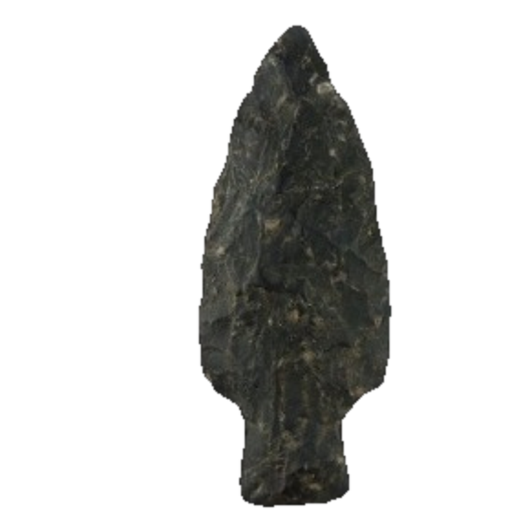
Arrowhead type
Durst Point
DurstLamoka Cluster3,500 - 2,500 B.P.Late Archaic10 reference photos
Key facts
- Age
- 3,500 - 2,500 B.P.
- Cultural period
- Late Archaic
- Size
- Small to Medium
- Shape
- Expanding Stem
- Glacial period
- Neoglacial
More from the Archaic period
Description
This triangular point exhibits a medium thickness and an expanding stem, characterized by an elliptical profile. The blade's curvature is predominantly excurvate, although some smaller specimens display a more linear configuration. The parallel notches are typically wider than they are deep, with a shoulder that often slopes upward, while others feature horizontal shoulders. The stem's shape can vary, ranging from slightly expanding to fully expanding or straight. The base is generally convex or straight, often bearing evidence of grinding. The manufacturing process involves a combination of rough percussion flaking and pressure flaking, resulting in a random, irregular flaking pattern. Overall, the point's craftsmanship is relatively crude, with a emphasis on functional simplicity.
Size
The dimensions of the arrowheads are characterized by the following measurements: they range in length from 21 to 70 mm, with an average length of 35 mm. The stem, which typically accounts for approximately one-third of the overall length, measures between 11 and 15 mm. The blade width varies from 13 to 29 mm, while the neck width spans from 7 to 12 mm. The stem width ranges from 8 to 16 mm, and the thickness of the arrowhead is between 5 and 10 mm.
Distribution
This refers to a localized variant of the Lamoka point, predominantly discovered in northern Illinois, eastern Iowa, southeastern Minnesota, and extensively across Wisconsin. Refer to supplementary notes on its presence within the Ohio River valley region
Additional information
In the realm of Native American arrowheads, a distinct cluster of points has been identified, characterized by smaller, thicker, and cruder specimens. This cluster is referred to by various names, depending on the geographical distribution. The University of Minnesota categorizes it as the Durst Stemmed cluster, while Justice (1987) designates it as the Lamoka cluster. For the purpose of this discussion, we will adopt the term Lamoka Cluster, acknowledging that it is synonymous with the Durst Stemmed and Dustin points. Notably, the nomenclature varies by region: in northern Ohio and eastward, these points are known as Lamoka points, whereas in the Michigan area, they are referred to as Dustin points, and in northern Illinois and eastward, they are called Durst Stemmed points (W2/Justice 1987).
The decision to list these points separately is driven by the desire to provide a detailed account of their distribution and naming conventions, ultimately facilitating regional identifications. By recognizing the subtle differences in terminology, researchers can better understand the cultural and geographical contexts in which these arrowheads were crafted. The Lamoka point, in particular, exhibits a coarser manufacture compared to other similar types, such as the Table Rock, Bottleneck, and Apple Blossom points. Despite these differences, the Lamoka point shares a common ancestry with these other types, highlighting the complex and nuanced nature of Native American arrowhead production.
The study of the Lamoka Cluster offers valuable insights into the technological and cultural developments of Native American societies. By examining the distribution and characteristics of these points, archaeologists can reconstruct the migration patterns, trade networks, and cultural exchange that shaped the lives of these ancient communities. As we continue to refine our understanding of the Lamoka Cluster, we may uncover new information about the historical contexts in which these arrowheads were created, used, and discarded, ultimately enriching our appreciation for the rich cultural heritage of Native American societies.
Identified by
- Named by
- Warren L. Wittry
- Year
- 1959
- Type site
- Durst Rockshelter, Sauk County, Wisconsin
Similar types
Types that are easy to confuse with the Durst point.
- Apple Blossom
- Benton Bottleneck
- Kay Blade
- Koster
- Table Rock
- Fort Dodge