
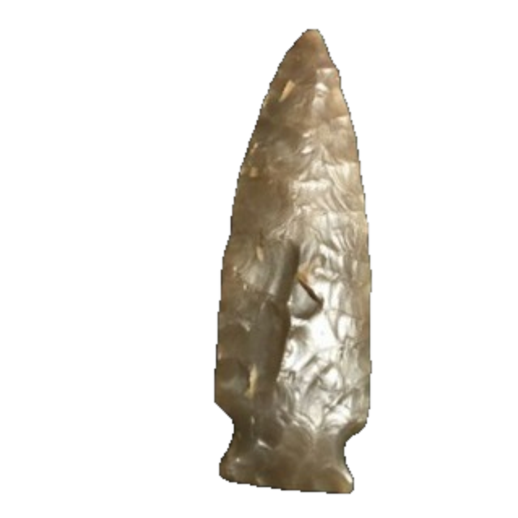
Arrowhead type
Besant Point
BesantPlains Large Corner Notch Cluster1,900 - 1,300mB.P.Middle Archaic to Late Archaic16 reference photos
Key facts
- Age
- 1,900 - 1,300mB.P.
- Cultural period
- Middle Archaic to Late Archaic
- Culture
- Besant Culture
- Size
- Small to Medium
- Shape
- Side Notch
- Material
- Quartzite
- Glacial period
- Roman Warm to Vandal Minimum (Scandic Period)
More from the Archaic period
Description
This triangular point exhibits a distinctive morphology, characterized by a broad, medium-sized blade with a triangular silhouette and a cross-sectional profile that ranges from flattened to elliptical. The blade's curvature varies, spanning from excurvate to occasionally straight, with the maximum width typically occurring just above the notches. The notches themselves are shallow and parallel, forming angled shoulders that often slope upward, although some specimens may display nearly horizontal shoulders. The stem is short and expands outward, featuring rounded basal corners or ears. The base of the point can be straight or concave, often with evidence of basal thinning and grinding. The manufacturing technique employed involves random percussion flaking, supplemented by pressure flaking to refine and retouch the blade, resulting in a random, multi-directional flaking pattern.
Size
The dimensions of the arrowheads are as follows: they range in overall length from 25 to 80 mm, with stem lengths spanning 8 to 11 mm. The blade itself measures between 19 and 26 mm in width, while the neck width falls within the range of 13 to 18 mm. Additionally, the stem width varies from 17 to 25 mm.
Distribution
These artifacts predominantly occur in regions spanning Alberta and Saskatchewan, extending into Montana, North Dakota, and Minnesota. They can also be located in northern Wyoming, South Dakota, and northern Iowa, albeit with lesser regularity.
Additional information
The earliest arrowhead style within this cluster is attributed to the Pelican Lake culture, specifically the Pelican Lake points. Notably, these points co-occur with the Besant points, which are the earliest representatives of the Besant culture. The Samantha points emerged subsequently, potentially overlapping with the Besant points in terms of their chronological span. Research by Clark (1984) and Gregg and Davidson (1985) suggests that the Besant phase, particularly in its eastern manifestation, may have had strong ties to the Hopewell culture, potentially serving as a primary supplier of Knife River Flint within that exchange network.
The Besant culture's subsistence strategies are thought to have varied across their geographic range, encompassing nomadic bison hunting on the Northwestern Plains and early horticultural practices in the southeastern extremity of their territory, although archaeological evidence of domesticated plant foods within Besant components has yet to be discovered (Morrow, 2016). In terms of typology, Besant points bear a resemblance to Matanzas points but are distinguished by their shorter and wider morphology (Morrow, 1984). Initially fashioned as dart points, Besant points underwent a transformation into arrow points over time. The Samantha and Besant types exhibit overlapping characteristics and dates, leading Morrow (2016) to propose that the Samantha type may be a variant of the Besant point, highlighting the complexities of cultural and technological evolution within this archaeological context.
The evolution of these arrowhead styles offers valuable insights into the technological and cultural developments of the Besant culture and its interactions with neighboring cultures. The transition from dart to arrow points, for instance, reflects adaptations to changing hunting practices and environmental conditions. Furthermore, the potential links between the Besant culture and the Hopewell culture underscore the significance of exchange networks in shaping the material culture and subsistence strategies of prehistoric societies. By examining the characteristics and chronology of these arrowhead styles, researchers can reconstruct a more nuanced understanding of the cultural and technological dynamics at play in this region during the relevant time period.
Identified by
- Named by
- Boyd Wettlaufer and Brian O.K. Reeves
- Year
- 1956
- Type site
- Mortlach Site, near Moose Jaw, Saskatchewan
Similar types
Types that are easy to confuse with the Besant point.
- Avonlea Carmichael
- Avonlea Gulf Lake
- Avonlea Timber Ridge
- Bratton
- Little Sioux
- Nanton
- Sandy Creek
- Simonsen
- Sonota
Other types in the Plains Large Corner Notch Cluster
- Samantha
- Pelican Lake