
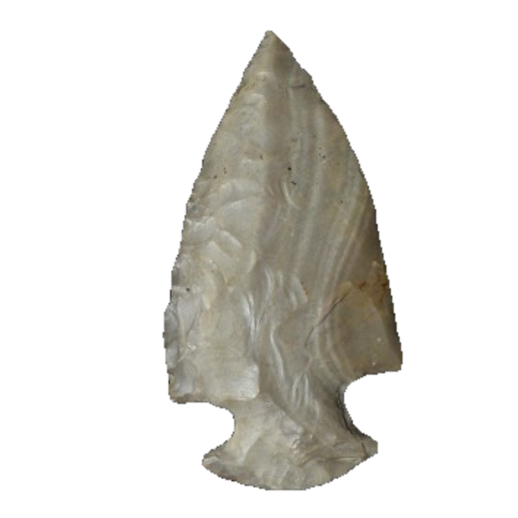
Arrowhead type
Gibson Notched Point
Gibson NotchedSnyders Cluster2,000 - 1,500 B.P.Woodland19 reference photos
Key facts
- Age
- 2,000 - 1,500 B.P.
- Cultural period
- Woodland
- Culture
- Hopewell Culture
- Size
- Small to Medium to Large
- Shape
- Side Notch to Corner Notch
- Glacial period
- Roman Warm
More from the Woodland period
Description
This triangular point exhibits a medium to large size range, characterized by a low side-to-corner notch configuration. Its cross-sectional profile is predominantly flattened, although thicker specimens may display a more elliptical shape. The blade morphology is typically excurvate, but a subset of examples features a straight blade. The point's maximum width is situated just above the shoulder area, where the tangs at the base are often comparable in width to the shoulders themselves. The notches that define the shoulders are deep and rounded, forming a shoulder morphology that can vary from slightly barbed to upwardly sloping. The stem is broad and expanding, terminating in a convex base that lacks basal grinding. The point's manufacture involves a combination of random percussion flaking and marginal pressure flaking, resulting in a random flaking pattern.
Size
The arrowheads exhibit a range of dimensions, with overall lengths spanning 40 to 100 mm. The stem, which forms the base of the arrowhead, measures between 10 and 16 mm in length. In terms of width, the blade itself ranges from 23 to 45 mm, while the neck, which connects the blade to the stem, is between 16 and 24 mm wide. Furthermore, the stem's width is recorded as being between 20 and 30 mm.
Distribution
This type is predominantly linked to Missouri, Illinois, and the Mid-Mississippi River region, extending into the Ohio River basin. It is also discovered in the Tennessee River Valley, albeit with lesser regularity.
Also found, less often, in
Additional information
The multifaceted nature of Native American arrowheads is exemplified by the diverse range of purposes they may have served, from utilitarian functions such as knives and scrapers to more symbolic roles as ceremonial objects. A notable example of this versatility is the Snyders point, which exhibits a wide range of variations that likely catered to different needs and time periods. The Hopewell and Snyders points, in particular, are thought to have been employed in ceremonial contexts, whereas the Affis Snyders point and the Manker point appear to have been used for more mundane, everyday activities.
The classification and cultural association of these point types are subjects of ongoing debate among archaeologists. Some researchers suggest that the variations within the Snyders point category, such as the Affis Snyders and Manker points, may not be true variations at all, but rather points used by distinct cultural groups. This perspective highlights the complexity of interpreting the archaeological record and the need for careful consideration of the cultural and historical contexts in which these artifacts were created and used.
It is also worth noting that the Snyders point can be easily mistaken for the St. Charles Dovetail, particularly in cases where the base of the point is pronouncedly convex. This similarity underscores the importance of meticulous analysis and attention to detail in the identification and classification of Native American arrowheads. By examining the subtle characteristics and variations within these point types, archaeologists can gain a deeper understanding of the cultural, technological, and historical contexts in which they were crafted and used, ultimately shedding light on the lives and traditions of the indigenous peoples who created them.
Identified by
- Named by
- Edward G. Scully
- Year
- 1951
- Type site
- Klunk-Gibson Mounds #4, Calhoun County, Illinois
Similar types
Types that are easy to confuse with the Gibson Notched point.