
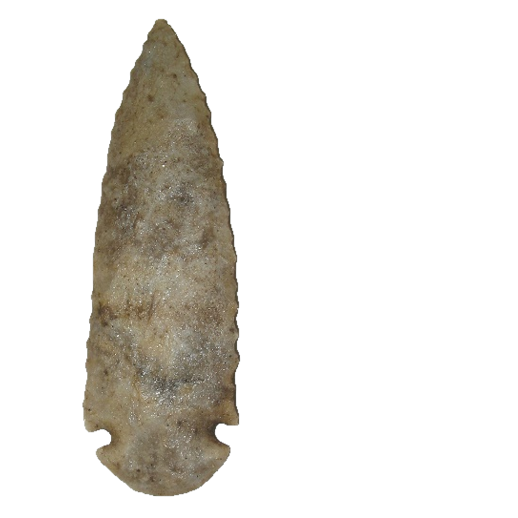
Arrowhead type
St Charles Dovetail Point
St Charles DovetailThebes Cluster10,000 - 8,000 B.P.Early Archaic38 reference photos
Key facts
- Age
- 10,000 - 8,000 B.P.
- Cultural period
- Early Archaic
- Size
- Medium to Large
- Shape
- Corner Notch
- Glacial period
- Early to Middle Holocene
More from the Archaic period
Description
This corner-notched point exhibits a size range from medium to large, characterized by a cross-sectional shape that fluctuates between elliptical and rhomboid. The blade profile is predominantly excurvate, although re-sharpening can result in a straight or recurvate edge. The blade edges may display alternating beveling or serrations. The shoulders are typically barbed, but some specimens may have straight shoulders. Notably, the notches are diagonally oriented, often deep and narrow. The stem expands outward, while the base is consistently convex, never straight. Both the base and notches frequently show evidence of heavy grinding. The manufacturing process involves even percussion flaking, supplemented by selective pressure flaking to refine and trim the blade, yielding a random flaking pattern. The craftsmanship of this point is often of high quality, with no indication of heat treatment being applied during its production.
Size
The dimensions of the arrowheads are as follows: they range in overall length from 45 to 160 mm, with a mean length of 65 mm. The stem portion measures between 12 and 17 mm in length, averaging 15 mm. The blade itself spans 26 to 40 mm in width, with an average width of 34 mm. The stem width varies from 24 to 31 mm, averaging 27 mm. In terms of thickness, the arrowheads measure between 7 and 10 mm.
Distribution
These artifacts are typically discovered throughout the Midwestern region. They are most prevalent in the Ohio River Basin and extending into the central Mississippi River basin. They can also be encountered less often in areas such as Minnesota, southeast Oklahoma, and northeast Texas
Additional information
The St. Charles point, a distinctive Native American arrowhead, was initially believed to date back to the Late Archaic to Early Woodland period. However, a discovery in Alabama by Cambron in 1964 led to a reevaluation of its chronology, correctly identifying it as an Early Archaic point. This correction prompted the naming of the point found at the Plevna Site in Alabama as the Plevna point, due to the discrepancy in time periods. Further research by Justice in 1987 revealed that the St. Charles and Plevna points were, in fact, the same type. Despite this clarification, some researchers in the Tennessee River Valley continue to refer to beveled St. Charles points as Plevna points.
A closer examination of the St. Charles point reveals notable variations, with Robert Converse identifying three distinct types: the Small Base Dovetail, Wide Base Dovetail, and the less common Notched Base variant, as noted by Justice in 1987. Charles Edler's 1990 study proposed nine variations of the St. Charles point, although the validity of these variations as distinct types has been questioned, with some attributing them to individual point idiosyncrasies. More recent research by Morrow in 2016 highlights the characteristic narrow, deep notch of the St. Charles point, distinguishing it from the round base Hardin point, which features a wide V notch. Morrow also discusses the Hardove point, which he believes represents an intermediate form between the Hardin and St. Charles points.
The St. Charles point's beveled variants, often referred to as "Plevna Variants," showcase the complexity and diversity of Native American arrowhead typology. The evolution of our understanding of the St. Charles point, from its initial misdating to the recognition of its variations and relationships with other point types, underscores the importance of ongoing research and collaboration in the field of archaeology. By examining the subtle differences and characteristics of these arrowheads, researchers can gain a deeper understanding of the cultural and historical contexts in which they were created, ultimately enriching our knowledge of Native American cultures and their technological and artistic achievements.
Identified by
- Named by
- Edward G. Scully
- Year
- 1951
- Type site
- Various sites in St. Charles County, Missouri
Similar types
Types that are easy to confuse with the St Charles Dovetail point.