
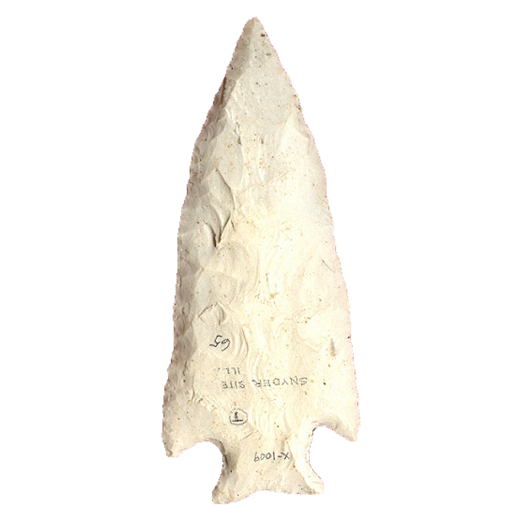
Arrowhead type
Stilwell Point
StilwellKirk Corner Notch Cluster9,500 - 8,500 B.P.Early Archaic25 reference photos
Key facts
- Age
- 9,500 - 8,500 B.P.
- Cultural period
- Early Archaic
- Size
- Medium to Large
- Shape
- Corner Notch
- Glacial period
- Early Holocene
More from the Archaic period
Description
This triangular corner-notched point exhibits a medium to large size profile, characterized by a cross-sectional shape that ranges from flattened to elliptical. The blade's curvature is predominantly excurvate, although some specimens may display a straight or recurvate profile. Serrations are often present, varying in depth from fine to pronounced. The shoulders are typically barbed, but can appear more horizontal in instances where the point has undergone extensive reworking. The stem expands outward, while the base can exhibit a range of concavity, from slight to deep, often accompanied by rounded basal lobes. Although basal thinning is a common feature, basal grinding is relatively rare in this point type. The flaking pattern is defined by broad percussion flaking visible on both faces, complemented by fine pressure flaking along the edges, resulting in a random, multi-directional pattern.
Size
The arrowhead's dimensions are as follows: its overall length ranges from 73 to 199 mm, with the stem section measuring between 9 and 15 mm in length. The maximum width of the arrowhead is between 32 and 44 mm, while the stem's width varies from 25 to 38 mm. The neck width is measured at 20 to 30 mm. In terms of thickness, the arrowhead's dimensions fall within two ranges: 7 to 9 mm and 3 to 8 mm, with an average thickness of 6 mm. Additionally, the basal concavity is observed to be between 1 and 5 mm.
Distribution
This type is located throughout the central Ohio River region, extending into the upper Tennessee River area, and the southern Illinois River area. They can also be found in the central Mississippi River region
Also found, less often, in
Additional information
In the aftermath of the Hardaway occupation, a notable shift occurred in the design of projectile points, as observed by Coe in 1959. This transition marked the emergence of a distinct small corner-notched serrated variety, characterized by extensive grinding along the base. Concurrently, there was a significant increase in the utilization of small hafted snub-nosed scrapers. The co-occurrence of these artifacts is noteworthy, as they often appear alongside Kirk Corner Notch points. However, the two point types can be distinguished by their basal characteristics, with the newly introduced variety exhibiting a concaved base and less pronounced shoulders, as highlighted by Justice in 2002. This differentiation is crucial for accurately identifying and categorizing these archaeological findings.
The introduction of this small corner-notched serrated point type signals a significant development in the technological and cultural repertoire of the region's inhabitants. The presence of extensive grinding along the base suggests a deliberate effort to refine and enhance the point's functionality, potentially indicating a greater emphasis on precision and effectiveness in hunting and gathering practices. Furthermore, the increased use of small hafted snub-nosed scrapers implies a growing reliance on these tools for processing and preparing materials, possibly reflecting changes in subsistence strategies or social organization.
The distinction between this point type and Kirk Corner Notch points, as noted by Justice, underscores the importance of meticulous analysis and attention to detail in archaeological research. By recognizing and interpreting these subtle differences, researchers can gain a more nuanced understanding of the cultural and technological dynamics at play during this period. The characteristics of these projectile points, including their basal features and serration patterns, offer valuable insights into the lives and practices of the people who created and used them, providing a window into the complexities of their daily lives and cultural traditions.
Identified by
- Named by
- Gregory Perino
- Year
- 1970
- Type site
- Stilwell Site, Pike County, Illinois
Similar types
Types that are easy to confuse with the Stilwell point.
- Brewerton Corner Notch
- Crawford Creek
- Kings
- Lost Lake
- Neuberger
- Thebes
Other types in the Kirk Corner Notch Cluster
- Amos
- Charleston Corner Notch
- Decatur
- Kirk Corner Notch
- Palmer
- Pine Tree Corner Notch