
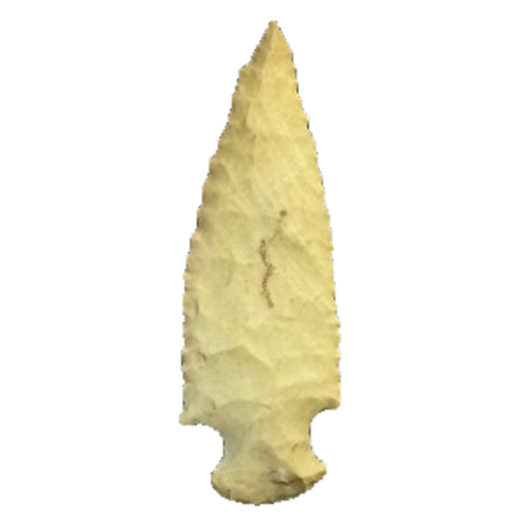
Arrowhead type
Cupp Point
Cupp1,300 - 600 B.P.Mississippian to Prehistoric16 reference photos
Key facts
- Age
- 1,300 - 600 B.P.
- Cultural period
- Mississippian to Prehistoric
- Size
- Medium to Large
- Shape
- Corner Notch to Side Notch
- Material
- Pottery
- Glacial period
- Vandal Minimum to Medieval
More from the Mississippian period
Description
This corner notch point exhibits a slender profile, with a size range spanning medium to large, and an elliptical shape in cross-section. The blade's curvature can vary, presenting as straight, excurvate, or slightly incurvate, particularly in resharpened specimens, and may feature serrations. The shoulder morphology ranges from subtly barbed to horizontal. Characteristically, the stem is short and expands outward, while the base is convex and unmodified by basal grinding or smoothing, resulting in a distinctive, untreated edge. Notably, the stem can display a faint asymmetry. The point's manufacture involves primary percussion flaking, supplemented by skilled secondary pressure flaking to refine the edges. The dominant flaking pattern, resulting from broad percussion flaking, presents a random, non-uniform arrangement across the point's faces.
Size
The dimensions of these arrowheads are characterized by a total length ranging from 40 to 200 mm, with an average measurement of 82 mm, which is typically three times the length of the width. The stem itself measures between 10 to 20 mm in length. The blade width varies from 20 to 45 mm, averaging 32 mm. Additionally, the neck width spans from 13 to 25 mm, while the stem width ranges from 18 to 25 mm.
Distribution
This projectile is mainly discovered in the central region of the Mississippi River Valley and extending into the Illinois River Valley. This type may also appear in eastern Oklahoma and northeastern Texas, albeit with lesser regularity.
Also found, less often, in
Additional information
In the realm of Native American arrowheads, a distinct type has been identified, bearing resemblance to the Motley type, yet exhibiting notable differences. A key distinguishing feature of this point is its shorter stem, which sets it apart from its Motley counterpart. Additionally, the notches on this type are generally wider, and the base is characterized by a strong convex shape, deviating from the typical Motley point morphology. Furthermore, this point tends to be smaller in size compared to the Kay Blade point, highlighting the diversity of arrowhead designs among Native American cultures.
The discovery of these points is often associated with Neosho Pottery, as well as Neosho points, which were described in detail by Perino in 2002. This co-occurrence provides valuable insights into the cultural and temporal contexts of these artifacts. Notably, Neosho points tend to have a longer, more rounded stem than the points in question, underscoring the subtle yet significant variations that exist within arrowhead typologies. By examining these differences, archaeologists can gain a deeper understanding of the technological, social, and cultural developments of Native American societies.
The study of these arrowheads offers a unique window into the lives of Native American communities, revealing the intricacies of their technological and artistic expressions. The presence of these points alongside Neosho Pottery and other diagnostic artifacts enables researchers to reconstruct the cultural landscape of the region, shedding light on the interactions, trade networks, and cultural exchange that shaped the lives of these ancient communities. As archaeological research continues to uncover new evidence, our understanding of Native American arrowheads and their associated cultures will become increasingly nuanced, providing a richer appreciation for the complexity and diversity of human experience in North America.
Identified by
- Named by
- David A. Baerreis and Joan E. Freeman
- Year
- 1959
- Type site
- Bluff Shelter Site, Ponotoc County, Oklahoma
Similar types
Types that are easy to confuse with the Cupp point.