
Arrowhead type
Big Creek Point
Big Creek3,500 - 2,500 B.P.Early Archaic14 reference photos
Key facts
- Age
- 3,500 - 2,500 B.P.
- Cultural period
- Early Archaic
- Size
- Small to Medium
- Shape
- Corner Notch
- Glacial period
- Neoglacial
More from the Archaic period
Description
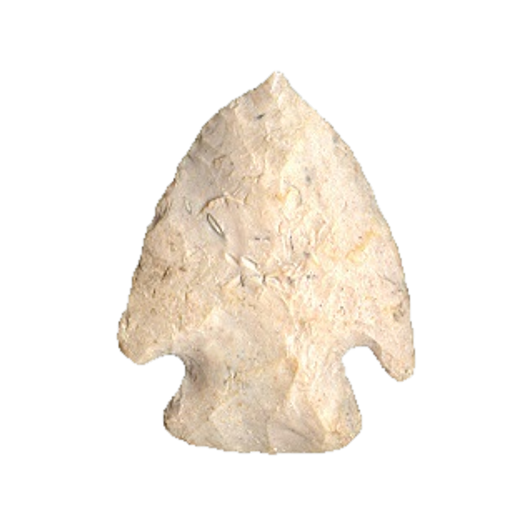
This corner notch point exhibits a compact to moderate size, characterized by a cross-sectional profile that ranges from flattened to elliptical. The blade itself is notably broad, with a predominantly excurvate shape that can sometimes impart a pentagonal silhouette. A distinctive feature of this point is its tapered tip, which often inclines inward to form a sharp, mucronate point. The shoulders are typically barbed, displaying a range of barb lengths from subtle to pronounced. The corner notches are expansive, with a convex base that adds to the point's overall geometry. The stem is generally short and broad, assuming an ovoid or bulbous contour. A characteristic feature of this point is the presence of light basal grinding, which is typically subtle. The flaking pattern on this point is random, lacking a discernible order or sequence.
Size
The dimensions of the arrowheads are as follows: they range in overall length from 30 to 65 mm, with a mean length of 48 mm. The stem measures between 11 and 20 mm in length, averaging 15 mm. The blade width varies from 19 to 47 mm, with an average width of 34 mm. The stem width ranges from 18 to 28 mm, averaging 24 mm. Additionally, the neck width falls between 17 and 25 mm, with a mean of 20 mm. In terms of thickness, the arrowheads measure between 7 and 11 mm.
Distribution
These artifacts are mainly located in northern Arkansas, the eastern Ozark region, and extending into southeast Missouri. This type can also be discovered less often in northeast Oklahoma and southern Illinois
Additional information
In the realm of Native American arrowheads, a distinctive point type exhibits characteristics that warrant careful examination. Notably, this point bears a resemblance to both the Snyders and Affis Snyders points, yet it can be discerned from these types by its more slender notch. A comparative analysis with the Big Slough point reveals that, while similar, this point is generally smaller in size. However, it is essential to approach identification with caution, as smaller specimens of the Big Slough point may be difficult to distinguish from this particular point type, highlighting the need for meticulous consideration of morphological details, as noted in reference (W11).
Identified by
- Named by
- Dan F. Morse
- Year
- 1970
- Type site
- Multiple site along Big Creek, northeastern Arkansas
Similar types
Types that are easy to confuse with the Big Creek point.