
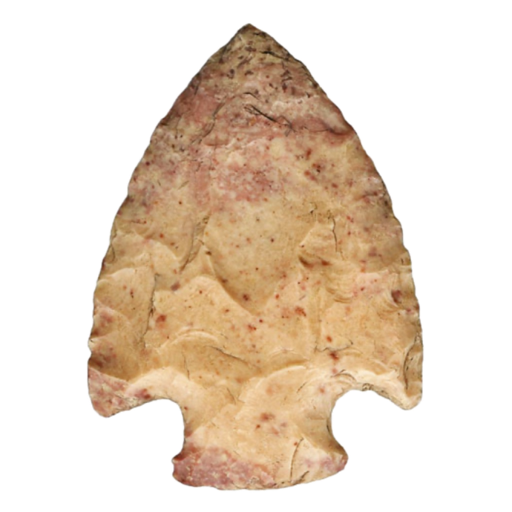
Arrowhead type
Hopewell Point
Hopewell2,100 - 1,700 B.P.Middle Woodland / Hopewell tradition — part of the broader Hopewell interaction sphere of the Eastern Woodlands.4 reference photos
Key facts
- Age
- 2,100 - 1,700 B.P.
- Cultural period
- Middle Woodland / Hopewell tradition — part of the broader Hopewell interaction sphere of the Eastern Woodlands.
- Size
- Medium
- Shape
- Stemmed to Notched
- Glacial period
- Late Holocene
More from the Woodland period
Description
These projectile points are typically medium to large bifacially flaked tools with broad blades and well-crafted workmanship. Many show careful thinning and/or use of high-quality chert or flint. A common form (often called a “Snyders” cluster of points) has a broad blade, may have barbed or flared shoulders, and an expanding or slight contracting stem. They may have been used as darts or knives, and in some cases may have had ceremonial or status-tool functions rather than purely functional hunting use
Size
Typical measurements for one recognized Hopewell point type: length 42–75 mm (~1.65–3.0 inches), width 25–40 mm (~1.0–1.6 inches), thickness 8–9 mm (~0.3–0.35 inches). Blades are broad, often with excurvate edges. Shoulders may be weakly barbed or angled. Stems are typically short, expanding or sometimes contracting. Bases are often convex or slightly concave. Cross-sections tend to be lenticular (thin in profile). Many examples display high craft quality and are made from exotic raw materials.
Distribution
Hopewell projectile points are most common in the Ohio River Valley and into the Great Lakes region (Ohio, Indiana, Illinois, Michigan). They also occur in lesser numbers in the upper Mississippi Valley, the Arkansas River valley, and the Tennessee River valley, reflecting the far‐reaching trade/interaction networks of the Hopewell tradition.
Additional information
The Hopewell points are often found in mound-and-earthwork contexts and in association with exotic materials like copper, mica, and marine shell, reflecting high ritual and exchange significance. The high craftsmanship, choice of raw material, and context suggest that many of these points may have had symbolic or status use, not simply functional hunting. Variation in style across different Hopewell groups is substantial, and several “clusters” of point types exist (e.g., Snyders cluster) that are considered diagnostic of Hopewell-era activities.