
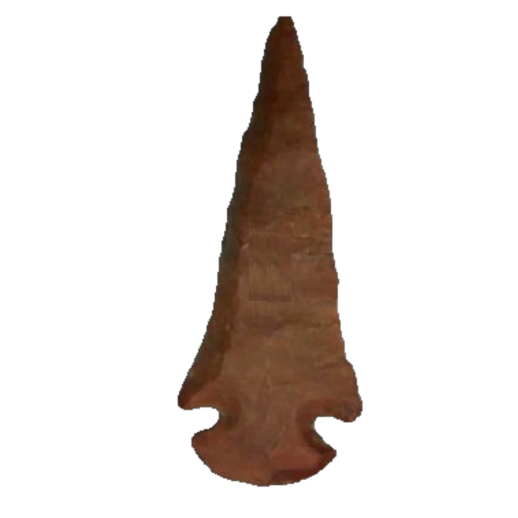
Arrowhead type
Becker Point
Becker9,000 - 8,500 B.P.Early Archaic9 reference photos
Key facts
- Age
- 9,000 - 8,500 B.P.
- Cultural period
- Early Archaic
- Size
- Medium to Large
- Shape
- Corner Notch to Side Notch
- Material
- Chert
- Glacial period
- Early Holocene
More from the Archaic period
Description
This projectile point exhibits a distinctive medium-sized triangular corner notch, characterized by a rhomboidal cross-sectional profile. The blade morphology varies from straight to incurvate, often featuring alternating beveling that creates a unique edge geometry. The shoulders are typically adorned with serrations, accompanied by barbed elements, and give way to an expanding stem. The basal portion of the point is marked by a convex shape that has been carefully thinned, likely to enhance hafting security. The flaking pattern observed on this specimen is random, suggesting a lack of formalized flaking strategy during its manufacture.
Size
The arrowheads exhibit the following dimensional characteristics: length ranges from 34 to 61 mm, with a mean length of 48 mm, while the width varies between 19 and 41 mm, averaging 29 mm. Additionally, the thickness of these artifacts spans from 6 to 10 mm, with an average thickness of 8 mm.
Distribution
This specimen was documented in Mississippi
Mainly found in
Additional information
In the realm of Native American archaeology, a specific type of arrowhead has been identified and categorized based on its distinctive characteristics. Initially, Cambron designated these points as Plevna Points, drawing from examples unearthed at the Plevna Site in Alabama. Subsequently, they were incorporated into the broader St. Charles type classification. However, MaGahey later introduced the term "Becker" to describe these points, which were discovered in Mississippi. Notably, the Becker points exhibit a close relationship with the Decatur type points, as observed by MaGahey in 2000. Furthermore, the Becker points are chronologically significant, as they precede the emergence of Lost Lake and Pine Tree points, highlighting their importance in the developmental sequence of Native American arrowhead technology, also noted by MaGahey in 2000.
The Becker points' association with the Decatur type points underscores the complex and dynamic nature of Native American cultural exchange and technological evolution. The fact that Becker points antedate Lost Lake and Pine Tree points suggests a gradual refinement of arrowhead design, potentially driven by functional requirements or cultural preferences. By examining the characteristics and chronological context of Becker points, researchers can gain valuable insights into the lives and traditions of Native American communities in the region, particularly during the period when these points were in use.
The classification and study of Becker points, alongside other arrowhead types, contribute to a deeper understanding of Native American cultural and technological development. By analyzing the distribution, morphology, and temporal context of these points, archaeologists can reconstruct the historical narrative of Native American communities, shedding light on their social, economic, and cultural practices. The work of researchers like Cambron and MaGahey has been instrumental in shaping our understanding of these artifacts, and continued study of Becker points and related arrowhead types will likely yield further discoveries and a more nuanced appreciation of Native American heritage.
Identified by
- Named by
- Samuel O. McGahey
- Year
- 2001
- Type site
- Hester site, Monroe County, Mississippi
Similar types
Types that are easy to confuse with the Becker point.