
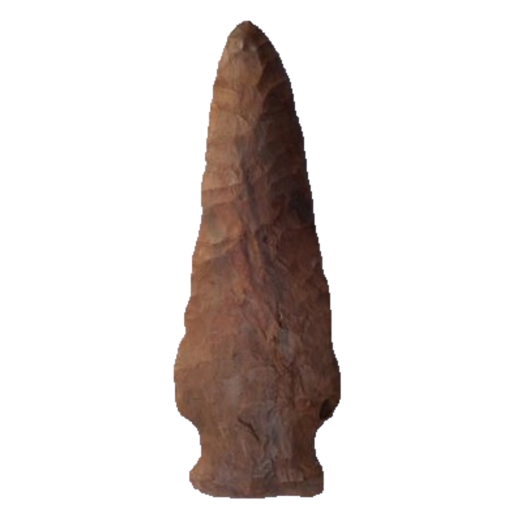
Arrowhead type
Epps Point
EppsMotley Cluster3,300 - 2,200 B.P.Late Archaic to Early Woodland13 reference photos
Key facts
- Age
- 3,300 - 2,200 B.P.
- Cultural period
- Late Archaic to Early Woodland
- Culture
- Poverty Point Culture
- Size
- Medium to Large
- Shape
- Expanding Stem to Corner Notch
- Glacial period
- Neoglacial to Roman Warm
Description
This triangular point exhibits a size range of 1.5 to 4 inches, characterized by a stem that broadens towards its base. In cross-section, the point's profile can range from an elliptical shape to one featuring a median ridge on either one or both of its faces. The blade itself is slender, measuring between 0.75 and 1.25 inches in width, and its edge can be straight or subtly curved outward. Some specimens display serrations along the blade's edge or exhibit right-hand beveling. The shoulders of the point are typically oriented horizontally, although they may be slightly barbed or angled upward. Notches on this point are distinctive, being both wide and deep, and often result in a narrowed neck and an elongated stem. The stem's base is either straight or mildly convex, expanding outward from the point's body. The flaking pattern observed on this point is random, lacking a consistent or deliberate pattern.
Size
The dimensions of the arrowheads are as follows: they range in overall length from 45 to 100 mm, with a mean length of 51 mm. The stem, which typically accounts for approximately one-third of the total length, measures between 13 and 18 mm, averaging 15 mm. The blade itself spans 20 to 35 mm in width, with an average of 26 mm. The neck and stem widths are recorded as 12 to 20 mm and 18 to 25 mm, respectively, with averages of 14 mm and no average given for stem width, only a range.
Distribution
This type is mainly discovered in eastern Louisiana and extending into southern Arkansas, where it is linked to the Poverty Point tradition. It can also be located, albeit less often, in western Louisiana, eastern Texas, and western Mississippi
Mainly found in
Additional information
In a notable observation, Justice (1987) proposed that a particular type of arrowhead may be a reworked example of the Motley type, potentially having undergone re-sharpening. However, a more extensive analysis conducted by Web, which encompassed over 250 specimens, revealed distinct differences that set this type apart from the Motley type. Specifically, Web's study found that these arrowheads were characterized by a thicker profile and a slightly cruder craftsmanship, distinguishing them as a separate entity.
This finding underscores the importance of thorough examination and analysis in archaeological classification. By scrutinizing a large dataset, Web was able to identify subtle yet significant variations that justified the recognition of this type as distinct from the Motley type. The thicker and cruder characteristics of these arrowheads suggest a potentially different functional or cultural context, warranting further investigation into their origins and uses.
The distinction between this type and the Motley type has significant implications for our understanding of the technological and cultural developments of the associated Native American groups. Further research into the manufacturing techniques, distribution, and chronological placement of these arrowheads may provide valuable insights into the lives and traditions of the people who created them. By continuing to refine our knowledge of these artifacts, we can gain a deeper appreciation for the complexity and diversity of Native American cultures, as well as the ingenuity and craftsmanship that they exhibited in their daily lives.
Identified by
- Named by
- James A. Ford and Clarence Webb
- Year
- 1956
- Type site
- Poverty Point, Louisiana
Similar types
Types that are easy to confuse with the Epps point.