
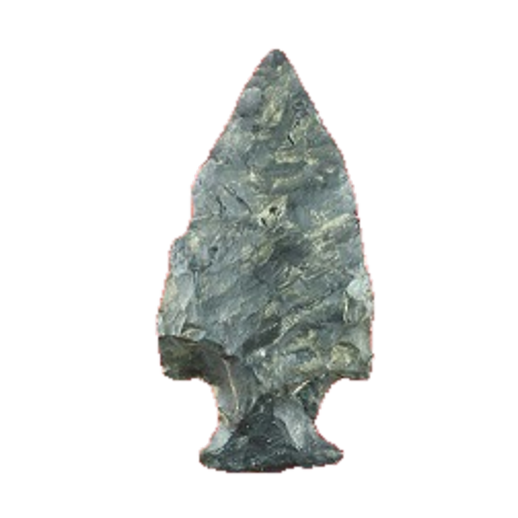
Arrowhead type
Motley Point
MotleyMotley Cluster3,300 - 2,200 B.P.Late Archaic to Early Woodland28 reference photos
Key facts
- Age
- 3,300 - 2,200 B.P.
- Cultural period
- Late Archaic to Early Woodland
- Size
- Medium to Large
- Shape
- Expanding Stem to Corner Notch to Side Notch
- Glacial period
- Neoglacial to Roman Warm
Description
This triangular expanding stem point measures between 2 to 3 inches in length, exhibiting a cross-sectional profile that transitions from flattened to elliptical. The blade's curvature is predominantly slight, with a subtle outward sweep, although some specimens may display a straighter profile. A distinctive, deeply rounded notch is evident, serving to truncate the preform's corners and create a shoulder that can vary in morphology, ranging from a pronounced barb to a horizontal or upward-angled orientation. The presence of deep, parallel notches at the corners imparts a narrow, constricted neck to the point. The basal edge varies in shape, spanning a range from straight to convex, and may be thinned, although basal grinding is typically not a characteristic feature. The manufacturing process involves the application of broad, high-pressure flaking, supplemented by finer, more precise pressure flaking to refine the edges, resulting in a random, non-patterned flaking arrangement.
Size
The dimensions of the arrowheads are as follows: they range in overall length from 45 to 115 mm, with a mean length of 64 mm. The stem measures between 14 and 17 mm in length, averaging 15 mm. The blade width varies from 27 to 42 mm, with an average width of 31 mm. The stem width ranges from 18 to 26 mm, averaging 18 mm. The neck width is between 11 and 14 mm, with a mean of 12 mm. In terms of thickness, the arrowheads measure between 7 and 10 mm.
Distribution
This type is predominantly located in the southern regions of the Mississippi and Tennessee river basins. It can also occur in the Ohio river basin and extend into the Great Lakes area. Additionally, it may appear in the Red River Valley of northeastern Texas and eastern Oklahoma
Additional information
In examining the characteristics of the arrowhead cluster in question, it becomes apparent that while they share certain similarities with Snyders points, a notable distinction lies in the neck width. Specifically, the points in this cluster exhibit a narrower neck, whereas Snyders type points are typically marked by a wider neck. A prominent representative of this cluster is the Motley point, which is not only the most predominant but also serves as a basis for understanding local variations, such as the Atalissa and Tipton points, as noted by Justice in 1987. These variations are considered to be regional adaptations of the Motley point, highlighting the diversity within this archaeological context.
The Motley point can be differentiated from other types, such as the Epps point, through distinct morphological features. The Epps point is characterized by strongly barbed shoulders and a straight base, distinguishing it from the Motley point. Interestingly, the Motley point bears some resemblance to the Tablerock type, particularly in terms of notch placement and shoulder formation. A closer examination reveals that the notches on Motley points typically originate from the corner of the preform, resulting in a shoulder that is either horizontal or slightly barbed. In contrast, the notches on Tablerock points enter the preform from a more lateral position, leading to a shoulder that is not only horizontal but also occasionally exhibits an upward angle and rounding.
The meticulous analysis of these arrowhead types underscores the complexity and variability of prehistoric tool manufacture. The subtle differences in shoulder formation, notch placement, and base shape are critical for identifying and categorizing these artifacts. By recognizing these characteristics, archaeologists can gain insights into the technological, cultural, and geographical contexts in which these tools were created and used. The study of these arrowhead types, including the Motley, Epps, and Tablerock points, contributes significantly to our understanding of the lives and traditions of Native American communities, highlighting the importance of continued research and documentation of these invaluable cultural artifacts.
Identified by
- Named by
- William G. Haag
- Year
- 1955
- Type site
- Motley Place Site, northeastern Louisiana
Similar types
Types that are easy to confuse with the Motley point.