
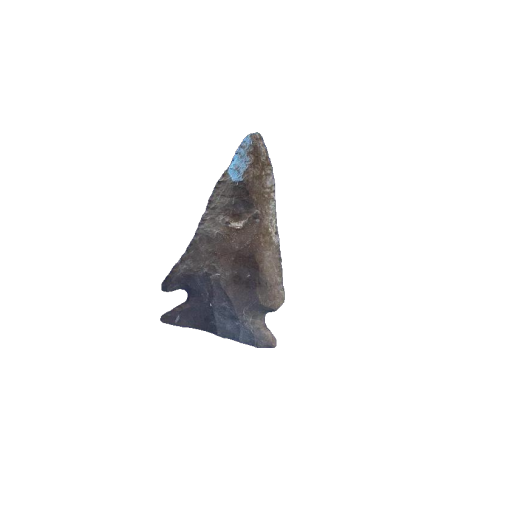
Arrowhead type
Amos Point
Amos7,300 - 6,300 B.P.Late Archaic to Transitional Archaic21 reference photos
Key facts
- Age
- 7,300 - 6,300 B.P.
- Cultural period
- Late Archaic to Transitional Archaic
- Size
- Small to Medium
- Shape
- Corner Notch
- Material
- Jasper
- Glacial period
- Middle Holocene
More from the Archaic period
Description
This triangular corner notch point exhibits a distinctive elliptical profile, with a predominantly straight blade bearing deep serrations that terminate short of the median line. The serrations are crafted through the removal of oblique flakes, resulting in a sharp, needle-like apex. Notably, the tip may be slightly asymmetrical, a characteristic often observed in re-sharpened specimens, which can also display finer serrations. The corner notches are deeply incised, forming barbed shoulders of unequal length, with one shoulder typically extending further than the other, and an expanding stem. The base of the point is proportionally narrower than the shoulder, ranging from half to two-thirds of its width, and can vary in shape from straight to convex. The basal area exhibits evidence of thinning, achieved through the strategic removal of small flakes, often accompanied by subtle basal grinding. The basal corners, initially sharp, have been rounded through the removal of a few small flakes, contributing to the point's overall refined appearance. The flaking pattern is random, yet the point demonstrates a high level of craftsmanship, underscoring the skill of its creator.
Size
The arrowheads exhibit the following dimensional characteristics: their overall length ranges from 21 to 42 mm, with a mean length of 30 mm. The stem, which forms the base of the arrowhead, measures between 4 and 6 mm in length. The blade, the primary cutting edge, varies in width from 12 to 26 mm, with an average width spanning 15 to 20 mm. In contrast, the stem's width is narrower, falling within the range of 8 to 15 mm. The neck, which connects the blade to the stem, has a width of 5 to 12 mm. The notches, which are the recessed areas on either side of the stem, have a width of 5 to 8 mm and a depth of 6 to 9 mm. Lastly, the thickness of the arrowheads, a critical factor in their durability, ranges from 7 to 15 mm, with an average thickness of 9 mm.
Distribution
This point is mainly discovered near the principal waterways in the southern Allegheny region and the upper and middle sections of the Ohio River basin, extending up to the Kanawha River.
Mainly found in
Also found, less often, in
Additional information
In the realm of Native American arrowhead studies, the Amos point has often been misidentified as a Palmer type, a confusion noted by local archaeologist Bob Byard. This mix-up may stem from speculation by Betty Broyles, who suggested that Amos points could be found beneath the Kirk Horizon, had excavations at the St. Albans site been more extensive. However, a review of existing literature and excavation records reveals that no published findings or digs have uncovered Amos points at depths reaching the Kirk Horizon. According to Matthew Smith, all available radiocarbon (RC) data indicate that Amos points date to a period post-dating the Kirk Horizon, providing a crucial chronological marker for archaeologists seeking to understand the cultural and temporal contexts of these artifacts.
The distinction between Amos and Palmer points is significant, as it highlights the complexities of arrowhead typology and the need for careful analysis in archaeological research. By recognizing the unique characteristics of each point type, researchers can refine their understanding of the technological, social, and cultural developments of Native American groups across different regions and time periods. The St. Albans site, in particular, offers valuable insights into the lives of indigenous peoples in the area, and continued study of the artifacts uncovered there can shed light on the historical dynamics of the region.
The RC data pointing to a post-Kirk Horizon date for Amos points underscores the importance of integrating multiple lines of evidence in archaeological research. By combining radiocarbon dating with other forms of analysis, such as stylistic and morphological examination of the points themselves, researchers can build a more comprehensive picture of the past. As archaeologists continue to investigate the Amos point and its place within the broader context of Native American archaeology, they must remain attentive to the nuances of arrowhead typology and the potential for confusion between similar point types, ensuring that their findings contribute to a more accurate and detailed understanding of the region's rich cultural heritage.
Identified by
- Named by
- Betty Broyles
- Year
- 1976
- Type site
- John E Amos Power Plant site, Putnam County, West Virginia
Similar types
Types that are easy to confuse with the Amos point.
- Charleston Corner Notched
- Kirk Corner Notch
- Lost Lake
- Palmer
- Thebes
- Vestal
- Vosberg