
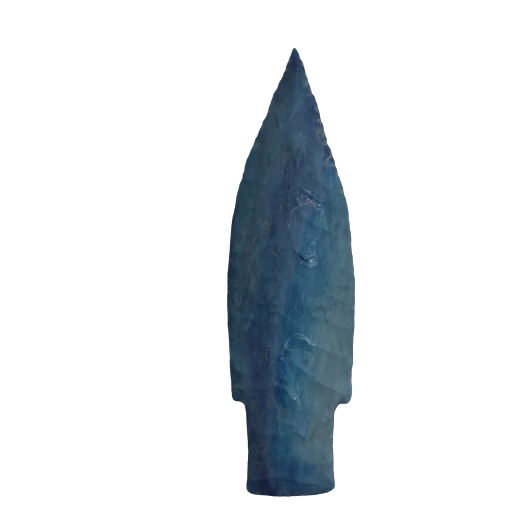
Arrowhead type
Delphi Point
DelphiTerminal Archaic Barbed Cluster3,500 - 2,000 B.P.Late Archaic to Early Woodland7 reference photos
Key facts
- Age
- 3,500 - 2,000 B.P.
- Cultural period
- Late Archaic to Early Woodland
- Size
- Medium to Large
- Shape
- Straight Stem to Expanding Stem
- Glacial period
- Neoglacial to Roman Warm
Description
This triangular stemmed point exhibits a medium to large size profile, characterized by an elliptical cross-sectional shape. The blade's curvature is predominantly excurvate, although some specimens may display a straight configuration. Notably, the blade's width is typically narrow, with occasional instances featuring beveled or serrated edges. The shoulders of the point vary in form, ranging from subtly barbed to horizontal or straight alignments. The stem's morphology can differ, spanning from straight and square to slightly expanding forms. The base of the point is generally straight or slightly convex, with rare exceptions displaying a concave profile. Overall, the workmanship of this point is often of high quality, reflecting a skilled manufacturing process. The flaking pattern observed on this point is random, lacking a discernible, organized arrangement.
Size
The dimensions of the arrowheads are characterized by the following measurements: overall length ranges from 43 to 100 mm, with a typical average span of 50 to 75 mm. The stem portion measures between 10 to 18 mm in length, averaging 12 mm. The blade width varies from 20 to 42 mm, with an average width of 34 mm. The neck width falls within the range of 13 to 20 mm, averaging 15 mm. The stem width is generally comparable to the neck width, but can be up to 3 to 5 mm wider in some cases. In terms of thickness, the arrowheads measure between 5 to 12 mm.
Distribution
The main concentration of this point is the southern Mississippi River Valley and extending into eastern Texas. It can also occur in the Tennessee River Valley, the Ohio River Valley, and throughout the central Mississippi River Valley.
Mainly found in
Also found, less often, in
Additional information
In the state of Illinois, the Pete Klunk Site has yielded a distinct type of arrowhead, classified as Kampsville Barbed points, specifically categorized as W2. Notably, Frank Schambach's research in 1998 positioned this particular point style as a variant of the Motley type, highlighting the complexities of Native American lithic typology. This classification underscores the significance of the Kampsville Barbed points within the broader context of regional archaeological findings.
The association of these points with the Motley type, as identified by Schambach, provides valuable insight into the cultural and technological exchanges that occurred among Native American groups in the region. The Kampsville Barbed points, with their unique characteristics, contribute to a deeper understanding of the evolutionary trajectory of arrowhead design and production. By examining the morphological features and distribution patterns of these points, researchers can reconstruct the dynamics of prehistoric cultural interactions and technological innovations.
The classification of the Kampsville Barbed points as a variant of the Motley type has important implications for the interpretation of archaeological assemblages in Illinois and beyond. This typological distinction enables researchers to refine their understanding of the chronological and spatial relationships between different Native American groups, ultimately enhancing our knowledge of the region's rich cultural heritage. As archaeological investigations continue to uncover new evidence, the study of Kampsville Barbed points and their connection to the Motley type will remain a vital area of inquiry, shedding light on the intricate history of Native American cultures in the region.
Identified by
- Named by
- Clarence Webb and James A. Ford
- Year
- 1956
- Type site
- Poverty Point Site, Louisiana
Similar types
Types that are easy to confuse with the Delphi point.
- Adena Narrow Stem
- Apple Creek
- Benton
- Bulverde
- Cedar Valley
- Darl
- Etley
- Ferry
- Genesee
- Grand
- Hardin
- Kings
- Motley
- Pickwick
- Pontchartrain
- Smithsonia
- Warito
Other types in the Terminal Archaic Barbed Cluster
- Buck Creek
- Wade