
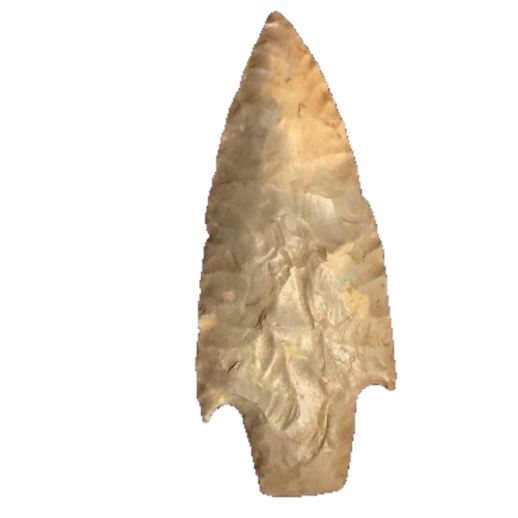
Arrowhead type
Bulverde Point
BulverdeTerminal Archaic Barbed Cluster5,000 - 3,500 B.P.Middle Archaic to Late Archaic22 reference photos
Key facts
- Age
- 5,000 - 3,500 B.P.
- Cultural period
- Middle Archaic to Late Archaic
- Size
- Medium to Large
- Shape
- Straight Stem to Expanding Stem to Contracting Stem
- Glacial period
- Middle Holocene to Neoglacial
More from the Archaic period
Description
This triangular stemmed point exhibits a medium to large size profile, characterized by an elliptical cross-sectional shape. The blade morphology can vary, displaying either an excurvate or straight configuration. The shoulders of the point can exhibit a range of barbing, from pronounced to subtle. In instances where re-sharpening has occurred, the shoulder may appear nearly horizontal. The stem itself can be straight or slightly tapering, while the base ranges from straight to mildly concave. Notably, the stem is rectangular in shape and features basal thinning, resulting in a slender, wedge-like profile, although the hafting region lacks smoothing. The flaking pattern on this point is random, with most examples showcasing fine, meticulous flaking and overall skilled craftsmanship.
Size
The dimensions of the arrowheads are characterized by a total length ranging from 45 to 90 mm. The stem, which constitutes approximately 1/3 to 1/4 of the overall length, measures between 11 and 22 mm. In terms of width, the arrowheads span 15 to 20 mm.
Distribution
This projectile is mainly located in the central region of Texas. Its presence is less common in eastern Texas and western Louisiana. According to Bell (1958), it occasionally appears in Oklahoma, albeit infrequently
Mainly found in
Additional information
In the realm of Native American arrowhead typology, this particular point exhibits a notable affinity with the Carrolton point, albeit with a distinguishing characteristic: the absence of a smooth stem that is typically associated with the Carrolton type. Instead, its morphology bears a resemblance to the Travis point, although this point tends to be broader in shape and features more pronounced shoulders, complemented by a distinctive wedged base. A comparative analysis with the Pedernales point reveals a significant degree of similarity, with the primary exception being the lack of a bifurcated base, a characteristic that is otherwise diagnostic of the Pedernales type, as noted by Suhm and Krieger in their seminal 1954 study. This observation underscores the complexities and nuances inherent in the classification of Native American arrowheads, highlighting the importance of meticulous attention to detail in the identification and categorization of these artifacts.
Identified by
- Named by
- J. Charles Kelley
- Year
- 1947
- Type site
- Lehman Rock Shelter, Texas
Similar types
Types that are easy to confuse with the Bulverde point.
- Carrolton
- Delhi
- Morrill
- Oakalla
- Pedernales
- Pontchartrain
- Travis
- Wells
Other types in the Terminal Archaic Barbed Cluster
- Buck Creek
- Smithsonia
- Wade