
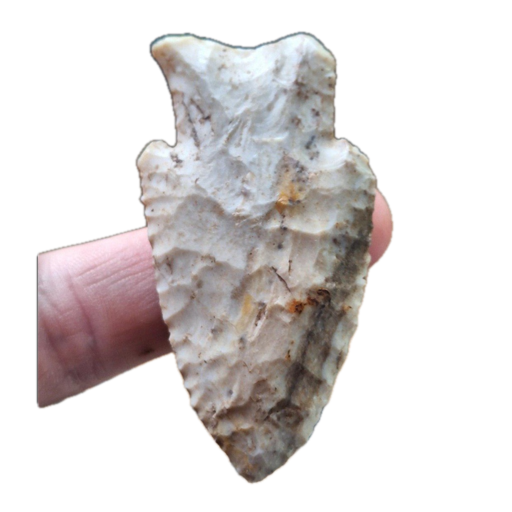
Arrowhead type
Hardin Point
HardinHardin Cluster10,500 - 7,500 B.P.Early Archaic37 reference photos
Key facts
- Age
- 10,500 - 7,500 B.P.
- Cultural period
- Early Archaic
- Size
- Medium to Large
- Shape
- Side Notch to Corner Notch to Expanding Stem
- Material
- Chert
- Glacial period
- Early to Middle Holocene
More from the Archaic period
Description
This triangular point exhibits a medium to large size, with a stem that expands in a distinctive manner. In cross-section, the shape can range from an elliptical to a rhomboid profile, particularly in specimens that have undergone re-sharpening. The blade itself is characterized by its slender, elongated form, which can display a range of curvature, from excurvate to straight. A notable feature is the sharp, V-shaped notch that forms at the junction of the shoulder and stem, often accompanied by a semicircular scar. The shoulders are barbed, adding to the point's distinctive morphology. The stem's shape can vary, ranging from straight to slightly expanding, as seen in the Hardin Barbed type, to more pronounced expansion, characteristic of the Hardin type. The base of the point is generally straight, although it can exhibit a slight convexity or concavity. A key characteristic of the base is the presence of pronounced basal thinning, achieved through pressure flaking, as well as extensive grinding along the basal and lateral edges, indicative of hafting. The point's manufacture involves a combination of even percussion flaking and selective pressure flaking, resulting in a random flaking pattern. The overall quality of workmanship is exceptionally high, reflecting a skilled level of craftsmanship.
Size
The arrowheads exhibit a range of dimensions, with total lengths spanning 45 to 180 mm, and averaging between 75 to 85 mm. Notably, the length is typically four times the width. The stem length varies from 11 to 22 mm, with an average of 17 mm. In terms of width, the arrowheads measure between 22 to 50 mm, with a average range of 35 to 40 mm. The stem width ranges from 22 to 32 mm, averaging 26 mm.
Distribution
This style is predominantly located in Wisconsin, Iowa, Illinois, and Missouri. It can also occur in eastern Oklahoma and western Indiana (main concentration area). Additionally, sightings have been recorded in the Tennessee River Valley and the Gulf Coastal area, although these are infrequent (secondary range). Powell (1990) proposed renaming it Florida Hardin in the secondary region
Mainly found in
Also found, less often, in
Additional information
In a notable classification discrepancy, the University of Minnesota initially grouped this particular point within the Plano Stemmed cluster, whereas Justice (1987) opted to exclude it from this category. Further examination reveals that this point does not align with the characteristics of the Cody Complex, prompting its reassignment to the Hardin Barbed Cluster, a classification also supported by Justice (1987). A key observation made by Wormington (1957) highlights the point's resemblance to the Scottsbluff point, albeit with a distinct absence of parallel flaking, a trait commonly associated with Scottsbluff points.
The evolutionary trajectory of these points is thought to have originated from the Scottsbluff points (W10), with the Hardin points exhibiting a unique set of characteristics that distinguish them from their predecessors. Notably, the distribution of Hardin points extends into the Tennessee River Valley and the Gulf Coastal region, with a specific subset found in this area being referred to as Southeastern Hardin by John Powell (1990). This regional designation underscores the point's significance within the context of Native American archaeology, particularly in the southeastern United States.
The classification and distribution of Hardin points offer valuable insights into the cultural and technological developments of Native American communities. The presence of these points in specific regions, such as the Tennessee River Valley and the Gulf Coastal area, highlights the complex networks of trade, migration, and cultural exchange that existed among prehistoric societies. By examining the characteristics and distribution of Hardin points, researchers can gain a deeper understanding of the historical context and cultural significance of these artifacts, ultimately contributing to a more comprehensive narrative of Native American archaeology.
Identified by
- Named by
- Edward G. Scully
- Year
- 1951
- Type site
- Multiple Sites in Calhoun County, Illinois
Similar types
Types that are easy to confuse with the Hardin point.
- Buck Creek
- Cypress Creek
- Decatur
- Ferry
- Kirk Corner Notch
- Lost Lake
- Patuxent
- Scottsbluff
- Stilwell