
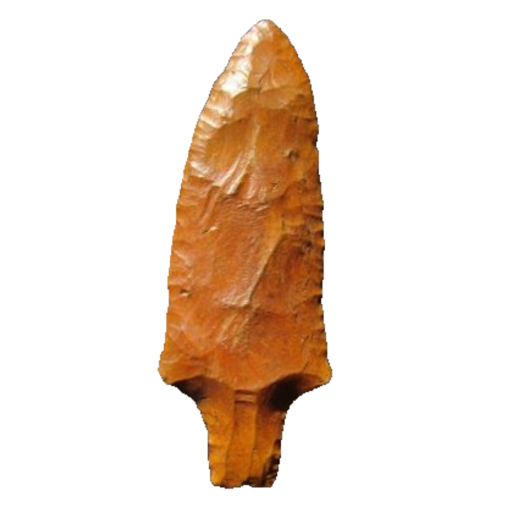
Arrowhead type
Pickwick Point
PickwickLedbetter Stemmed Cluster6,000 - 3,500 B.P.Middle Archaic to Late Archaic21 reference photos
Key facts
- Age
- 6,000 - 3,500 B.P.
- Cultural period
- Middle Archaic to Late Archaic
- Size
- Medium to Large
- Shape
- Straight Stem to Contracting Stem
- Glacial period
- Middle Holocene to Neoglacial
More from the Archaic period
Description
This triangular stemmed point exhibits a size range of 2.75 to 4 inches, characterized by a distinctive combination of features. In cross-section, the point can display a range of profiles, from elliptical to those featuring a median ridge on one or both faces. The blade shape is highly variable, spanning from excurvate to inwardly recurvate forms, and often presents an asymmetrical outline. Secondary pressure flaking is a common feature, resulting in the formation of serrations or beveling along the blade edges. The shoulders of the point can be oriented horizontally or at an upward angle, frequently exhibiting asymmetry, and in some instances, are barbed. The stem morphology ranges from straight to slightly contracting, while the base is typically straight, although some examples may display a subtle convex curvature. Remnants of cortex may be present on the base. The flaking pattern on this point is characterized by a random arrangement of flakes.
Size
The arrowheads exhibit the following dimensional characteristics: overall length ranges from 58 to 117 mm, with a mean length of 74 to 85 mm. The stem length varies between 9 and 19 mm, averaging 10 to 15 mm. In terms of blade dimensions, the width spans 35 to 60 mm, with an average width of 38 to 48 mm. At the shoulders, the stem width measures between 15 and 24 mm, averaging 17 to 22 mm. The basal width ranges from 12 to 21 mm, with an average of 14 to 18 mm. Thickness measurements fall within the range of 9 to 12 mm.
Distribution
This projectile is mainly discovered in the Tennessee River basin and along the Gulf Coast region. It is also located, albeit less commonly, in the southern parts of Illinois, Indiana, Ohio, and the Tennessee River drainage areas of North Carolina
Additional information
The emergence of this particular arrowhead type is observed during the Middle Archaic period, a timeframe marked by significant cultural and technological developments among Native American communities. Notably, its popularity and widespread use appear to have culminated between 3,500 and 3,000 years before present (BP), suggesting a period of peak production and utilization. This chronological window, denoted as W2, provides valuable insights into the technological and cultural preferences of the people who crafted and employed these arrowheads, highlighting the complex and dynamic nature of prehistoric tool use in North America.
Identified by
- Named by
- David DeJarnette
- Year
- 1962
- Type site
- Stanfield-Worley Bluff Shelter, Alabama
Similar types
Types that are easy to confuse with the Pickwick point.
- Appalachian
- Ashtabula
- Cotaco Wright
- Cottonbridge
- Etley
- Little Bear Creek
- Maples
- Mulberry Creek
- Savannah River
- Shoals Creek