
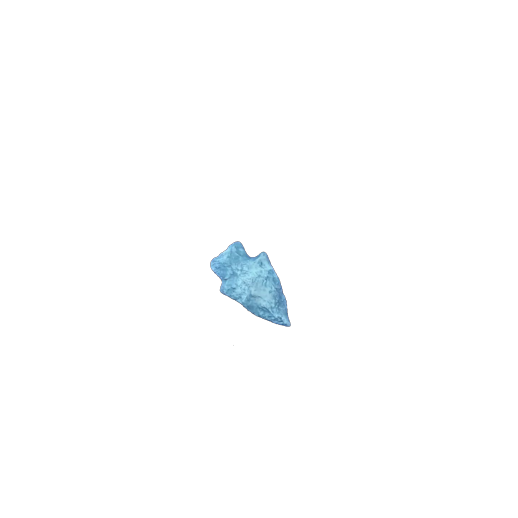
Arrowhead type
Apple Creek Point
Apple Creek1,700 - 1.500 B.P.Early Archaic22 reference photos
Key facts
- Age
- 1,700 - 1.500 B.P.
- Cultural period
- Early Archaic
- Size
- Medium to Large
- Shape
- Corner Notch
- Glacial period
- Roman Warm
More from the Archaic period
Description
This triangular point exhibits a distinctive morphology, characterized by a stem that broadens slightly towards its base, which can range from straight to concave in outline. The blade itself displays a subtle curvature, transitioning from a straight to a gently excurvate profile. Notably, the shoulders of the point are barbed, with these protrusions extending downwards along the stem for a distance equivalent to between one quarter and one half of the stem's total length. The cross-sectional shape of the point is elliptical, and the flaking pattern that covers its surface is random, lacking a discernible order or orientation. Overall, the point's dimensions are modest, falling within the small to medium size range.
Size
The dimensions of the arrowheads are as follows: they typically range in overall length from 45 to 95 mm, with a mean length generally falling between 55 and 65 mm. The stem portion measures between 10 and 17 mm in length. The blade itself spans a width of 20 to 40 mm. At the neck, the width is between 10 and 20 mm, averaging 13 to 18 mm. The basal section exhibits a width of 15 to 25 mm.
Distribution
This type is mainly discovered in Missouri and extends into western Illinois, eastern Kansas, southern Iowa, and northern Arkansas
Additional information
In a comparative analysis, the arrowhead in question bears a resemblance to the Kampsville point, a type of projectile point named after its discovery in Kampsville, Illinois. However, a closer examination reveals distinct differences between the two. Notably, the Kampsville point is characterized by more extensive flaking patterns, which suggests a variation in the manufacturing process. Furthermore, the material composition of the Kampsville point differs from that of the subject arrowhead, as it lacks the heat treatment that was employed in the production of the latter.
A key distinguishing feature between the two points lies in their basal morphology. The Kampsville point typically exhibits a straight to convex base, whereas the subject arrowhead displays a straight to concave base. This difference in basal shape may indicate variations in the functional or stylistic preferences of the cultures that produced these points. The presence of heat treatment in the subject arrowhead also implies a level of technological sophistication, as this process would have required a certain degree of control over pyro-technological processes.
The differences between these two points highlight the complexity and diversity of Native American lithic technology, particularly during the time periods in which these points were produced. By examining the variations in flaking patterns, material composition, and basal morphology, archaeologists can gain a deeper understanding of the cultural and technological contexts in which these arrowheads were created. Ultimately, a comprehensive analysis of these points can provide valuable insights into the lives and traditions of the indigenous cultures that crafted them.
Identified by
- Named by
- Gregory Perino
- Year
- 1963
- Type site
- Apple Creek Site, Illinois
Similar types
Types that are easy to confuse with the Apple Creek point.
- Helton
- Jacks Reef
- Kampsville
- Kirk
- Lundy
- Pine Tree