
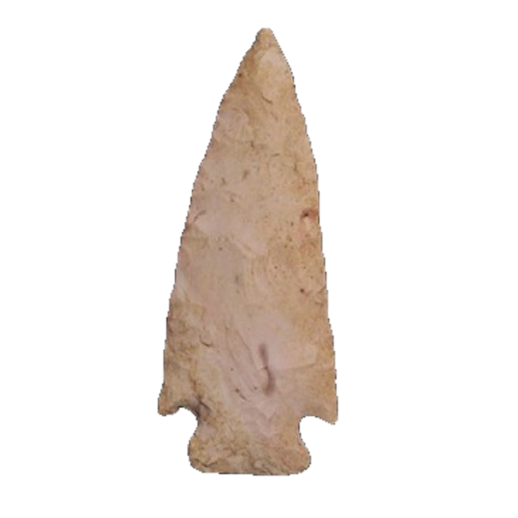
Arrowhead type
Ferry Point
Ferry5,500 - 4,500 B.P.Middle Archaic10 reference photos
Key facts
- Age
- 5,500 - 4,500 B.P.
- Cultural period
- Middle Archaic
- Size
- Medium to Large
- Shape
- Expanding Stem to Corner Notch
- Glacial period
- Middle Holocene
More from the Archaic period
Description
This triangular point exhibits a medium to large size profile, characterized by an elliptical cross-sectional shape. The blade itself is marked by an excurvate curvature and often features fine serrations along its edge. The shoulders of the point are typically oriented horizontally, although they may occasionally display a slight barbing or an upward inclination. The stem expands outward and may show evidence of grinding in the area where it would have been attached to a haft. The base of the point is commonly convex, sometimes taking on a bulbous form, but can also be straight in rare instances. Additionally, the base may exhibit subtle signs of grinding or thinning. The flaking pattern observed on this point is random, lacking a consistent or deliberate pattern.
Size
The dimensions of the arrowheads are as follows: they typically range in Total Length from 55 to 120 mm, with an average length of 60 to 70 mm. The Stem Length is measured between 12 to 20 mm. The width of the Blade is recorded as 30 to 44 mm, while the Stem Width at the shoulders varies from 18 to 26 mm. Additionally, the Maximum Stem Width is observed to be between 20 to 30 mm, although it is noted that this measurement is based on a limited sample size.
Distribution
This type is mainly discovered in Missouri and extends into central Illinois and Iowa, as well as southern Illinois
Additional information
In the realm of Native American archaeology, a particular type of arrowhead has garnered significant attention due to its distinctive characteristics and chronological significance. Initially identified as a Helton point at the Koster site, further research has revealed that this point actually predates the Helton point. Noted archaeologist William Fowler, in his 1983 publication, sheds light on the nuances of this point, highlighting two distinct variations. The more prevalent form is distinguished by its bulbous stem, a characteristic that sets it apart from other point types.
A less common, yet equally fascinating, variation of this point boasts a short, broad stem accompanied by sharp basal corners. This specific morphology has also been referred to as the Barbeau point, underscoring the complexity and diversity within the realm of Native American arrowhead typology. The presence of these variations not only expands our understanding of the technological and stylistic developments among Native American groups but also underscores the importance of meticulous classification and dating in archaeological research. By examining these subtle differences, researchers can glean valuable insights into the cultural, temporal, and geographical contexts in which these artifacts were crafted and utilized.
The study of these arrowhead variations, as discussed by Fowler, contributes to a deeper appreciation of the evolutionary trajectory of Native American projectile points, highlighting the dynamic interplay between form, function, and cultural expression. As archaeological inquiry continues to refine our understanding of these ancient artifacts, the nuances of points like the one found at the Koster site serve as a testament to the ingenuity and craftsmanship of Native American communities, offering a window into the lives and traditions of these ancestral groups.
Identified by
- Year
- 1959
- Type site
- Ferry Site, Hardin County, Illinois
Similar types
Types that are easy to confuse with the Ferry point.