
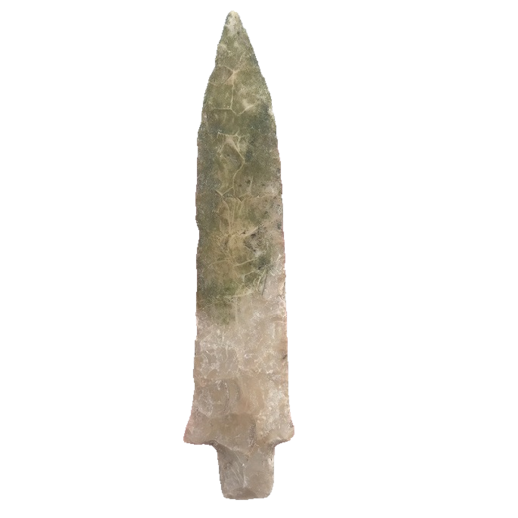
Arrowhead type
Etley Point
EtleyEtley Cluster4,100 - 2,500 B.P.Middle Archaic to Late Archaic35 reference photos
Key facts
- Age
- 4,100 - 2,500 B.P.
- Cultural period
- Middle Archaic to Late Archaic
- Size
- Large
- Shape
- Straight Stem to Contracting Stem to Expanding Stem
- Material
- Chert
- Glacial period
- Neoglacial
More from the Archaic period
Description
This triangular point exhibits a distinctive morphology, characterized by a stem that broadens outward, accompanied by a cross-sectional profile that transitions from flattened to elliptical. The blade's curvature can vary, ranging from excurvate to outwardly recurvate, with the longest dimension often running parallel to the blade's widest section, typically situated above the shoulder area. Extensive re-sharpening can alter the blade's shape, resulting in either an incurvate or recurvate form. The shoulder morphology is diverse, spanning from barbed to angled upward, with its shape influenced by the degree of re-sharpening. The stem is typically short, with a shape that can expand or slightly contract. The base of the point can be straight or mildly convex, lacking any evidence of basal or hafting region grinding. The manufacturing process involved broad percussion flaking, supplemented by limited pressure flaking, yielding a flaking pattern that appears random and unsystematic.
Size
The dimensions of the arrowheads are characterized by the following measurements: overall length ranges from 76 to 279 mm, while the stem length typically accounts for approximately one-tenth of the total length, spanning 10 to 15 mm. The barb length is between 6 and 10 mm. In terms of width, the arrowheads measure 32 to 60 mm, with the stem width narrower at 19 to 26 mm. The thickness of the arrowheads falls within the range of 10 to 15 mm.
Distribution
This type is most abundant in the St. Louis area and extends into eastern central Missouri and western central Illinois. It occurs less commonly in western Indiana, western Kentucky, and southern Iowa. This type has infrequently been discovered in southern Minnesota
Additional information
In the realm of Native American archaeology, the Wadlow blade holds significant interest, particularly in its proposed role as a precursor to the Etley point. According to research conducted by Morrow in 2016, these blades are considered preforms, suggesting that they were intentionally crafted as intermediate stages in the production of Etley points. This insight sheds light on the technological and manufacturing processes employed by ancient cultures, highlighting the complexity and sophistication of their tool-making traditions. By examining the characteristics and production sequences of Wadlow blades, archaeologists can gain a deeper understanding of the cultural and historical contexts in which these artifacts were created, ultimately enriching our knowledge of Native American technological and cultural development.
Identified by
- Named by
- Edward G. Scully
- Year
- 1951
- Type site
- Etley site, Oettle Farm, Calhoun County, Illinois
Similar types
Types that are easy to confuse with the Etley point.