
Arrowhead type
Wade Point
WadeTerminal Archaic Barbed Cluster3,500 - 2,500 B.P.Late Archaic to Early Woodland13 reference photos
Key facts
- Age
- 3,500 - 2,500 B.P.
- Cultural period
- Late Archaic to Early Woodland
- Size
- Medium
- Shape
- Basal Notch to Corner Notch to Expanding Stem
- Material
- Siltstone
- Glacial period
- Neoglacial
Description
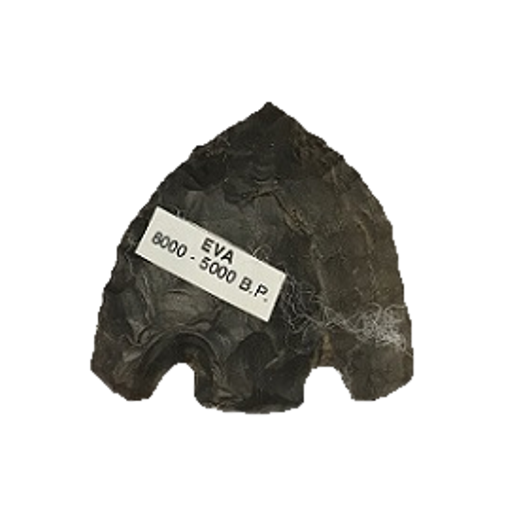
This triangular point, measuring between 1.5 to 2.5 inches in length, exhibits a distinctive basal notch and an elliptical to flattened cross-sectional profile. The blade's curvature is predominantly excurvate, although some specimens may display a straight configuration. Notably, the shoulders are characterized by pronounced barbs, which can be either short or, more frequently, extend to the base of the stem, thereby defining its classification as a basally notched point. The stem's morphology varies from straight to slightly expanding. The base of the point is generally straight, with some instances showing a subtle concavity. Additionally, the base often features basal thinning and basal grinding, indicative of deliberate edge modification. The flaking pattern observed on this point is random, lacking a discernible, organized arrangement.
Size
The dimensions of the arrowheads are as follows: - The overall length ranges from 39 to 70 mm, with an average length of 45 to 52 mm. - The stem measures between 9 to 15 mm in length, averaging 10 to 13 mm. - The blade width varies from 27 to 45 mm, with an average width of 34 to 37 mm. - At the shoulders, the stem width ranges from 10 to 19 mm, averaging 14 to 15 mm. - The stem width at the base is between 9 to 21 mm, with an average of 11 to 17 mm. - The thickness of the arrowhead is between 5 to 9 mm.
Distribution
This type is predominantly linked to the Tennessee River Valley region (encompassing Southern Kentucky, Tennessee, northern Alabama, and northeastern Mississippi), yet can also occur in the Ohio River Valley and extend into southern Michigan and eastern Missouri
Also found, less often, in
Additional information
In archaeological contexts, the discovery of certain projectile points has shed light on the cultural and technological practices of Native American communities. Notably, some point types have been found in association with Motley points, suggesting a shared cultural or functional significance. One such point type, characterized by its distinctive morphology, is often compared to the Kampsville point, which is commonly found in the Ohio River valley. A key distinguishing feature between these two point types is the length of the barb, with the Kampsville point exhibiting a longer barb. This subtle difference highlights the importance of meticulous analysis and classification in understanding the nuances of prehistoric technologies and cultural exchange networks. By examining the characteristics and distribution of these point types, researchers can gain valuable insights into the lives and traditions of Native American groups, ultimately enriching our understanding of the region's rich cultural heritage.
Identified by
- Named by
- James Cambron and David Hulse
- Year
- 1960
- Type site
- Several sites around Wade Landing, Tennessee River, Limestone County, Alabama
Similar types
Types that are easy to confuse with the Wade point.
- Apple Creek
- Calf Creek
- Elora
- Eva
- Kampsville
- Melville
- Pontchartrain
- Pulaski
- Rankin
- Shoals Creek
- Smith
- Smithsonia
Other types in the Terminal Archaic Barbed Cluster
- Buck Creek
- Bulverde
- Delhi