
Arrowhead type
Colby Fluted Point
Colby FlutedClovis Cluster11,700 - 10.000 B.P.Paleo3 reference photos
Key facts
- Age
- 11,700 - 10.000 B.P.
- Cultural period
- Paleo
- Size
- Medium to Large
- Shape
- Lanceolate
- Glacial period
- Late Pleistocene
More from the Paleo period
Description
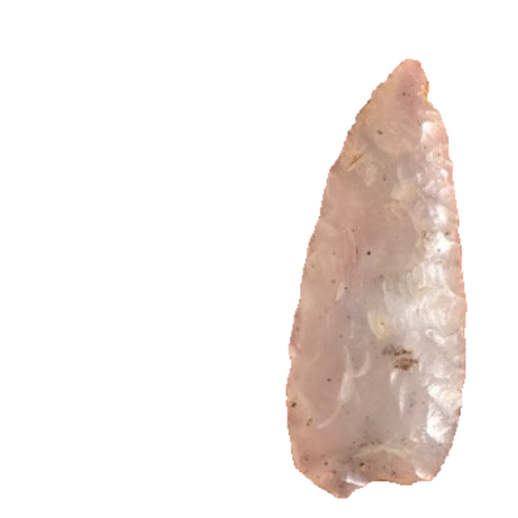
This lanceolate point exhibits a robust profile, characterized by a medium to large size and a cross-sectional morphology that is distinctly flattened. The blade itself displays a pronounced excurvate shape, with sides that run parallel to each other. Notably, the basal area is marked by a pronounced concavity, which in some instances gives way to a deep, notch-like formation. Both faces of the point feature fluting, a characteristic that is particularly evident in the lower portion of the blade. The fluting pattern typically covers between one-third to one-half of the blade's length, originating from the base. Upon closer examination, the point reveals a flaking pattern that is predominantly parallel to horizontal, with a transverse orientation that adds to its overall technical complexity.
Size
The dimensions of these arrowheads are characterized by a total length ranging from 60 to 150 mm, while the blade width spans from 28 to 46 mm, mirroring the measurements typically associated with the Clovis type.
Distribution
This type is mainly located in northern Utah and extends into western Wyoming and southeastern Idaho
Also found, less often, in
Additional information
The classification of Clovis style points has been a topic of ongoing discussion among archaeologists. One perspective suggests that the characteristic features of Clovis points exhibit a range of variation that is consistent across their geographic distribution, implying that these differences are a natural part of the type's overall morphology. In other words, the diversity seen in Clovis points may simply reflect the normal range of variation within a single, cohesive type.
Alternatively, some researchers propose that regional specialization played a significant role in the development of Clovis points, with certain areas exhibiting a higher frequency of specific variants. According to this view, these regional variants may represent later adaptations or unique subtypes that emerged from the broader Clovis point tradition. This perspective acknowledges that the Clovis point type may have undergone localized transformations over time, resulting in distinct subtypes that are more commonly found in specific areas.
Ultimately, the debate surrounding Clovis point classification highlights the complexity and nuance of understanding the evolution and distribution of this iconic archaeological type. By examining the variations within Clovis points and their geographic distribution, researchers can gain valuable insights into the technological, cultural, and historical contexts in which they were created and used. Further study of these enigmatic artifacts will continue to refine our understanding of the Clovis point tradition and its significance within the broader narrative of Native American cultural and technological development.
Identified by
- Named by
- George C. Frisoa
- Year
- 1978
- Type site
- The Colby Mammoth Site, Washakie County, Wyoming
Similar types
Types that are easy to confuse with the Colby Fluted point.
- Agate Basin
- Angostura
- Alder
- Barber
- Bat Cave
- Belen
- Black Rock
- Barnes
- Browns Valley
- Dalton
- Folsom
- Fredrick
- Lovell
- Midland
- Red Stone
Other types in the Clovis Cluster
- Anzick
- Clovis
- Clovis Hazel
- Clovis St Louis
- Clovis Tulare
- Clovis Un-fluted
- Debert
- Holcombe
- Ross County