
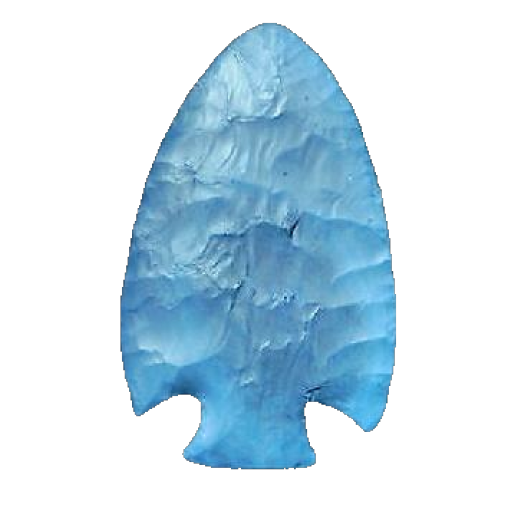
Arrowhead type
Affinis Snyders Point
Affinis SnydersSnyders Cluster2,200 - 1,800 B.P.Middle Woodland23 reference photos
Key facts
- Age
- 2,200 - 1,800 B.P.
- Cultural period
- Middle Woodland
- Culture
- Hopewell culture
- Size
- Medium
- Shape
- Corner Notch
- Glacial period
- Roman Warm
More from the Woodland period
Description
This triangular corner notch point exhibits a sturdy profile, characterized by a medium thickness and an elliptical shape in cross-section. Its blade, predominantly straight with occasional subtle curvature, is notable for its compact, broad proportions. The shoulders are distinguished by barbed tips, accompanied by a short, expanding stem that broadens outward. The base of the point is marked by a convex curvature. The flaking pattern observed on this artifact is random, lacking a discernible, organized arrangement.
Size
The arrowheads exhibit the following dimensional characteristics: their overall length ranges from 42 to 70 mm, while the stem length varies between 12 and 23 mm. In terms of width, the arrowheads measure between 31 and 60 mm, with an average width of 40 mm. The stem width ranges from 21 to 40 mm, averaging 27 mm. The neck width is between 19 and 25 mm, and the thickness of the arrowheads is consistently between 8 and 9 mm.
Distribution
This projectile is mainly identified in the Wabash Valley region of southern Illinois, Indiana, and extending into southwestern Ohio. Sightings have also been documented in central southern Ohio and the northernmost part of Michigan's Upper Peninsula. Nevertheless, their geographic range may overlap with that of the Snyders variant
Additional information
The functional diversity of Native American arrowheads is a fascinating aspect of archaeological study. These artifacts, which include the Snyders point, exhibit a range of variations that likely served different purposes, from utilitarian tools such as knives and scrapers to ceremonial objects. The Snyders point, in particular, displays a notable array of variations, which may have been used across different time periods or for distinct cultural practices.
Notably, the Hopewell and Snyders points are thought to have been employed in ceremonial contexts, whereas the Affinis Snyders point and the Manker point may have been used for more mundane, daily activities. This distinction highlights the complexity and nuance of Native American material culture, where the same artifact type could have been used in vastly different ways depending on the social and cultural context. The variations within the Snyders point tradition, including the Affinis Snyders and Manker points, have also sparked debate among scholars regarding their cultural attribution, with some arguing that these variants may have been used by other cultures, rather than representing genuine variations within the Snyders point tradition.
The study of these arrowhead variations offers valuable insights into the lives and cultural practices of Native American communities, particularly during the time periods associated with the Hopewell and Snyders points. By examining the functional and stylistic differences between these artifacts, researchers can gain a deeper understanding of the social, economic, and ceremonial dynamics that shaped the lives of these ancient cultures. Furthermore, the ongoing debate surrounding the cultural attribution of certain point variants, such as the Affinis Snyders and Manker points, underscores the complexity and richness of Native American archaeological record, highlighting the need for continued research and analysis to fully appreciate the significance of these enigmatic artifacts.
Identified by
- Named by
- Howard D. Winters
- Year
- 1963
- Type site
- Various sites, Wabash Valley, Illinois
Similar types
Types that are easy to confuse with the Affinis Snyders point.