
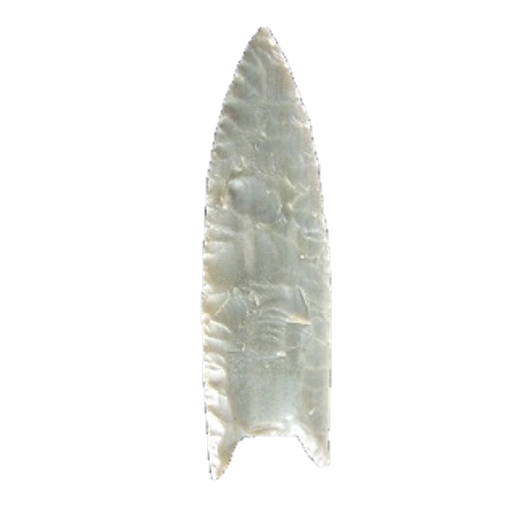
Arrowhead type
Folsom Fluted Point
Folsom FlutedFolsom Cluster10,900 - 9,500 B.P.Transitional Paleo20 reference photos
Key facts
- Age
- 10,900 - 9,500 B.P.
- Cultural period
- Transitional Paleo
- Size
- Small to Medium
- Shape
- Lanceolate
- Glacial period
- Late Pleistocene
More from the Paleo period
Description
This medium-sized, lanceolate point exhibits a slender profile with a distinctive biconcave cross-sectional shape, flattened to enhance its aerodynamic properties. The blade's curvature is predominantly excurvate, characterized by parallel sides that converge towards the tip. Notably, the blade's maximum width is typically situated within the upper third to half of its length, imparting a distinctive "stub-nosed" appearance. The basal edge is generally straight, although it may exhibit a subtle flare at the ears, resulting in a recurvate blade shape. The base itself is concave, often deeply so, with extensive grinding evident in the basal and hafting regions. In some instances, a residual nipple-like feature is visible at the base's center, representing the remnants of the fluting platform. The point's faces are often fully fluted, although the fluting may be limited to approximately 60% of the blade's length. The edges are meticulously finished with fine pressure flaking, demonstrating a high degree of craftsmanship.
Size
The dimensions of the arrowheads are as follows: they range in length from 22 to 80 mm, with a mean length of 46 mm. The maximum blade width varies between 13 and 28 mm, averaging 22 mm. The basal width spans from 16 to 22 mm, with an average measurement of 18 mm. Additionally, the thickness of the arrowheads falls within a range of 4 to 7 mm.
Distribution
This projectile is mainly discovered in the western Prairie area of North America and extends into the Rocky Mountains. This projectile occurs with reduced regularity into the Intermountain West to the west and into the Northeastern states to the east.
Mainly found in
Also found, less often, in
Additional information
The Folsom point represents the apex of fluting technology, characterized by a distinctive nipple platform at the base, which may still be visible on some intact specimens. This innovative technique is believed to have been employed in conjunction with a flaking method similar to that used in the production of Cumberland and Gainey Clovis points, as noted by Justice in 1987 and further supported by Morrow's research in 2016. The association of Folsom points with Pleistocene bison ranges was first observed by Suhm and Krieger in 1952, although controlled excavations have revealed that these points are not typically found in conjunction with either older Clovis points or newer Cody Complex points.
One of the notable challenges in identifying Folsom points lies in distinguishing them from other fluted points that may have been reworked or resharpened, a phenomenon highlighted by Morrow in 2016. As points are reworked, the blade length may be reduced, altering the flute-to-blade ratio and potentially giving the point a Folsom-like appearance. However, genuine Folsom points can be identified by their exceptional thinness and the presence of fine pressure retouch, which sets them apart from other fluted points. This level of craftsmanship and attention to detail underscores the significance of Folsom points in the context of Native American archaeology.
The Folsom point's unique combination of technological and stylistic characteristics has made it a subject of interest among archaeologists, with researchers continuing to refine our understanding of its production, use, and distribution. By examining the fluting technique, flaking method, and other distinctive features of Folsom points, researchers can gain valuable insights into the cultural and technological developments of the peoples who created these remarkable artifacts. As our knowledge of Folsom points evolves, so too does our appreciation for the ingenuity and skill of the Native American communities that produced them, highlighting the importance of continued research and study in this field.
Identified by
- Named by
- Jesse D. Figgins and H.M. Wormington
- Year
- 1926
- Type site
- Wild Horse Arroyo (Folsom Site), Union County, New Mexico
Similar types
Types that are easy to confuse with the Folsom Fluted point.