
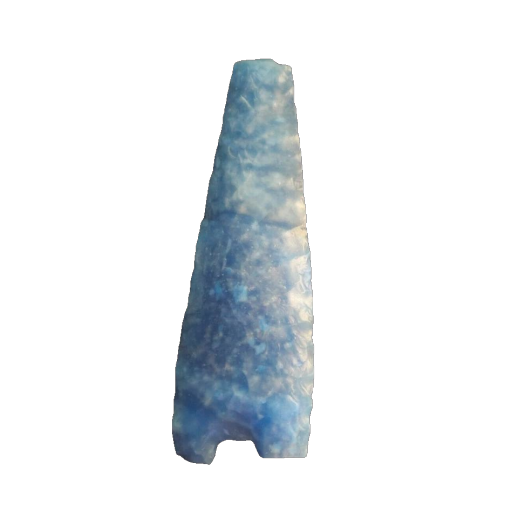
Arrowhead type
Allen Point
AllenPlano Lanceolate Cluster9,500 - 8,500 B.P.Transitional Paleo13 reference photos
Key facts
- Age
- 9,500 - 8,500 B.P.
- Cultural period
- Transitional Paleo
- Size
- Medium
- Shape
- Lanceolate
- Material
- Chert
- Glacial period
- Early Holocene
More from the Paleo period
Description
This lanceolate point exhibits a slender, triangular profile with a cross-sectional shape that transitions from elliptical to flattened. The blade's curvature is subtly outward, giving it a slightly excurvate appearance. Notably, the point's maximum width is typically situated above its base, which is characterized by a pronounced concavity. Evidence of grinding is often observed in the hafting region, suggesting intentional shaping for attachment. The flaking pattern on this point is distinguished by parallel oblique flakes, indicating a deliberate and controlled technique was employed in its manufacture.
Size
The arrowheads exhibit a range of dimensions, with overall lengths spanning from 45 to 120 mm, and averaging between 55 to 65 mm. The width of the blade itself varies from 18 to 33 mm, with a typical range of 22 to 26 mm. Additionally, the basal concavity of these arrowheads measures between 3 to 7 mm.
Distribution
This type is mainly discovered in the western grasslands and extending into the Rocky Mountain range. They appear to be linked with elevated terrain in these areas. These points are also discovered in the southern grasslands area and into northeastern New Mexico
Additional information
In a notable comparison, the archaeological specimen at hand bears a resemblance to the Fredrick point, yet exhibits a distinctive characteristic that sets it apart. Specifically, this point features a base with a more pronounced concavity, whereas the Fredrick point is typically defined by a base that is either straight or only slightly concave. This subtle yet significant difference highlights the nuances in morphology that can be observed among various point types, underscoring the importance of meticulous analysis in the classification and identification of these ancient artifacts. By examining the base concavity, researchers can gain valuable insights into the technological and stylistic preferences of the cultures that crafted these points, ultimately contributing to a more comprehensive understanding of the historical and cultural contexts in which they were created.
Identified by
- Named by
- William Mulloy
- Year
- 1959
- Type site
- James Allen Site, Laramie Basin, Wyoming
Similar types
Types that are easy to confuse with the Allen point.
- Agate Basin
- Alder
- Angostura
- Browns Valley
- Fourth of July
- Fredrick
- Golondrina
- Goshen
- Meserve
- Midland
- Plainview