
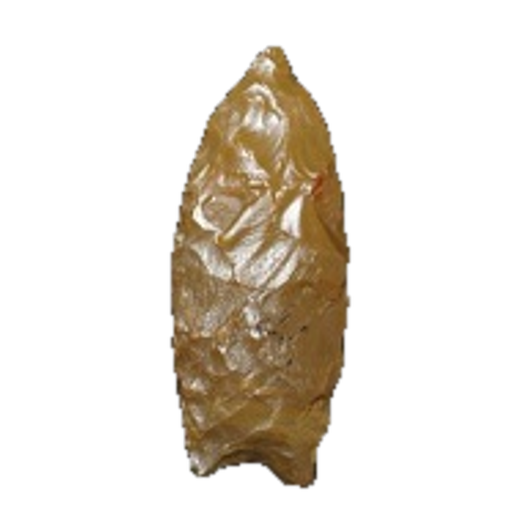
Arrowhead type
McKean Point
McKeanMcKean Cluster4,500 - 3,500 B.P.Middle Archaic17 reference photos
Key facts
- Age
- 4,500 - 3,500 B.P.
- Cultural period
- Middle Archaic
- Size
- Medium
- Shape
- Lanceolate to Basal Notch
- Glacial period
- Neoglacial
More from the Archaic period
Description
This lanceolate point exhibits a distinctive morphology, characterized by a medium size and a cross-sectional profile that is typically elliptical or features a pronounced median ridge, although some specimens may display a flattened cross section. The blade's curvature is excurvate, with its maximum width occurring roughly midway along its length. The basal morphology is variable, ranging from slightly concave to more deeply concave or notched. The point's manufacture involved an initial stage of random percussion flaking, followed by a finishing stage of well-controlled pressure flaking. This flaking sequence yields a pattern that can range from random to collateral, with the latter being the most common, or occasionally exhibits an oblique transverse arrangement.
Size
The dimensions of the arrowheads are as follows: they range in overall length from 35 to 61 mm, with a mean length of 51 mm. In terms of width, the maximum dimension falls between 14 and 21 mm, averaging 17 mm. The basal width is narrower, spanning 11 to 13 mm, with an average of 12 mm. The thickness of the arrowheads measures between 8 and 10 mm. Additionally, the basal concavity, which is the inward curvature at the base, varies from 2 to 6 mm, with an average depth of 4 mm, as reported by Wheeler in 1952.
Distribution
This projectile is a grassland variant that predominantly occurs in the Northern Grasslands. It is most frequently discovered in Canada, with sightings extending into Idaho, Utah, Colorado, and Nebraska. It is sporadically encountered on the Colorado Plateau, and is absent from the Great Basin. Morrow (2016) notes this type as infrequently encountered in Minnesota and Iowa. Bell (1958) occasionally situates this point in northwestern Oklahoma
Mainly found in
Also found, less often, in
Additional information
The McKean complex is a significant archaeological find, characterized by five primary point types and two notable variations. Among these, the McKean point, Duncan Point, Hanna Point, and Yonkee point are distinct categories, while the Southsider variation and Hanna Northern variation exhibit subtle differences. A key subtype within this complex is the Southsider Lanceolate, which displays a slight lateral edge restriction, giving it a unique appearance that borders on, but does not fully qualify as, a side-notched point. This characteristic was first observed by Drager and Irelans in 1986.
The Southsider Lanceolate was initially identified at the Southsider Cave site (48BH363) in Wyoming, and its morphology represents a transitional phase between the McKean and Duncan points. As a result, this subtype is often classified as either a McKean or Duncan point, depending on the degree of lateral edge restriction present. This ambiguity has led to the Southsider variation being referred to as a "Shouldered McKean," highlighting its intermediate position within the McKean complex. Similarly, the Duncan point is also sometimes referred to as a "Shouldered McKean," underscoring the close relationship between these two point types.
The McKean complex, including its various subtypes and variations, provides valuable insights into the technological and cultural developments of Native American communities. The subtle differences between these point types, such as the lateral edge restriction in the Southsider Lanceolate, demonstrate the complexity and nuance of archaeological classification. By examining these variations, researchers can gain a deeper understanding of the historical context and cultural exchange networks that shaped the lives of Native American communities, ultimately enriching our knowledge of their technological, social, and cultural practices.
Identified by
- Named by
- Richard P. Wheeler
- Year
- 1952
- Type site
- Multiple sites at Keyhole Reservoir, northeastern Wyoming
Similar types
Types that are easy to confuse with the McKean point.