
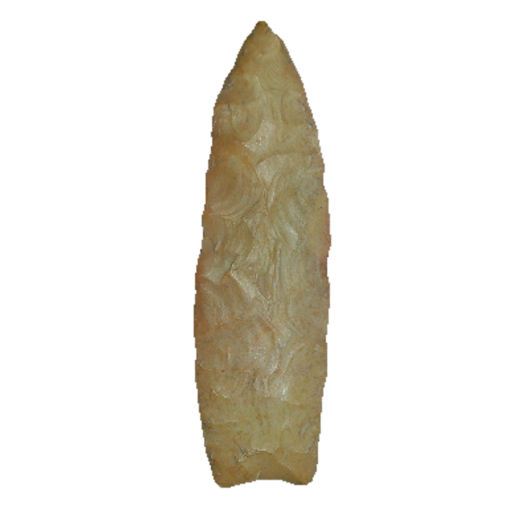
Arrowhead type
Goshen Point
GoshenPlano Lanceolate Cluster11,500 - 10,800 B.P.Late Paleo19 reference photos
Key facts
- Age
- 11,500 - 10,800 B.P.
- Cultural period
- Late Paleo
- Size
- Small to Medium
- Shape
- Lanceolate
- Material
- Iron
- Glacial period
- Late Pleistocene
More from the Paleo period
Description
This lanceolate point exhibits a distinctive auriculate shape, characterized by an elliptical cross-section and a curved blade profile. The blade's curvature is pronounced, with an initial inward curve at the tip that gradually straightens, becoming nearly parallel to the point's axis at its midpoint, before subtly reversing direction and curving inward once more towards the base. The base itself can display a range of concavity, from slight to pronounced, often accompanied by basal thinning. The basal corners may be either rounded or sharp. Notably, this point lacks fluting, but instead features basal thinning and evidence of grinding in the hafting region. The flaking pattern is marked by fine, precise pressure flaking and meticulous edge retouching, resulting in a pattern that can vary from oblique to transverse, often with a horizontal orientation. Overall, the point's flaking is well-executed, with a high degree of technical skill evident in its creation.
Size
The arrowheads exhibit a range of dimensions, with overall lengths spanning 50 to 110 millimeters and widths varying between 20 and 30 millimeters.
Distribution
This type is mainly discovered spanning the Northern to Southern Grasslands of Canada, the United States, and extending into Mexico. This type has also been identified in neighboring areas, albeit with lesser regularity.
Mainly found in
Also found, less often, in
Additional information
In his 1991 publication, Frison sheds light on the distinct characteristics of Goshen projectile points, noting that they exhibit a unique blend of technological and morphological features that set them apart from both Clovis and Folsom points, while still retaining some traits from both of these well-known Paleoindian traditions. A key aspect of Goshen points is their chronological positioning, as evidenced by radiocarbon dating conducted at the Mill Iron Site. The results indicate that the Goshen occupation at this site spans a narrow timeframe, averaging approximately 11,000 years before present (BP), with dates ranging from just over to just under 11,000 years BP.
This tightly constrained chronology has significant implications for our understanding of the Goshen complex and its relationship to other Paleoindian cultures. As Frison (1991) observes, the Goshen complex appears to have been contemporaneous with the Clovis culture, and may have even extended into the early stages of the Folsom period. This overlap highlights the complex and dynamic nature of Paleoindian cultural development, with various traditions coexisting and influencing one another over time. The Goshen complex, in particular, offers valuable insights into the technological and morphological innovations that characterized this period, as well as the social and cultural interactions that shaped the lives of early American hunter-gatherers.
The Mill Iron Site, with its well-dated Goshen occupation, provides a crucial reference point for understanding the broader context of Paleoindian cultural evolution. By examining the technological and morphological characteristics of Goshen projectile points, alongside the chronological data from the Mill Iron Site, researchers can gain a more nuanced appreciation for the complexities of Paleoindian cultural development, and the ways in which different traditions intersected and influenced one another over time. As such, the Goshen complex remains an important area of study, offering a unique window into the lives and cultural practices of North America's earliest human inhabitants.
Identified by
- Named by
- George C. Fraison
- Year
- 1988
- Type site
- Hell Gap Complex Site, Goshen County, Wyoming
Similar types
Types that are easy to confuse with the Goshen point.
- Clovis
- Folsom
- Green River
- Meserve
- Midland
- Milnesand
- Park Hill
- Plainview