
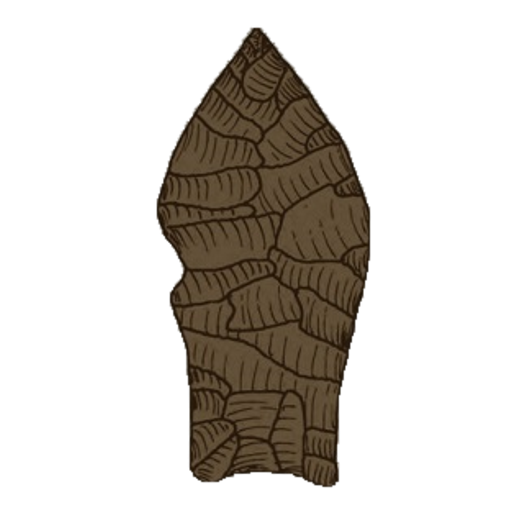
Arrowhead type
Coldwater Point
Coldwater11,000 - 10,500 B.P.Late Paleo8 reference photos
Key facts
- Age
- 11,000 - 10,500 B.P.
- Cultural period
- Late Paleo
- Size
- Medium
- Shape
- Auriculate to Lanceolate
- Glacial period
- Late Pleistocene
More from the Paleo period
Description
This lanceolate point exhibits a distinctive elliptical profile, with a medium-sized blade that sweeps outward in a gentle, excurvate curve before tapering inward towards the tip and reversing direction to converge at the waist. The shoulder regions are subdued, often barely perceptible, and are characterized by a rounded or upward-angled morphology. The stem and waist section is notably elongated, displaying a range of forms from straight to subtly expanding. The basal edge varies from straight to slightly concave, and evidence of hafting and basal grinding is clearly visible. The flaking pattern on this point is random, lacking a discernible order or orientation.
Size
The dimensions of these arrowheads are characterized by the following measurements: overall length ranges from 35 to 80 mm, with a mean length of 51 mm. The blade width varies between 20 and 40 mm, averaging 26 mm. The waist width is measured between 14 and 20 mm, while the basal width is slightly wider, exceeding the waist width by 1 to 3 mm. In terms of thickness, the arrowheads range from 4 to 10 mm, with an average thickness of 6 mm.
Distribution
This type is mainly discovered in the southern Mississippi River region and extends into the Red River basin and Tennessee River basin.
Also found, less often, in
Additional information
In the realm of Native American archaeology, a distinct category of projectile points has been identified, dating back to the late Paleo period. It is essential to note that the term "late Paleo points" should be used with caution, as it should not be applied to describe fluted points from the Paleo period, as emphasized by McGahey in 1981. A notable example of a late Paleo point is one that bears resemblance to the Pelican point, a type characterized by its unique morphology. However, a key distinguishing feature of this particular point is its relatively longer hafting region, which sets it apart from the more commonly encountered Pelican points.
The hafting region, which refers to the area where the point is attached to the shaft, is a crucial aspect of arrowhead design, as it affects the overall balance and functionality of the projectile. The longer hafting region observed in this type of point suggests a potential adaptation for specific hunting or cultural practices. Further analysis of this point type may provide valuable insights into the technological and cultural developments of the late Paleo period, shedding light on the lives and traditions of the indigenous peoples who crafted these artifacts.
The study of these points highlights the importance of precise classification and terminology in archaeology, as it enables researchers to reconstruct the complexities of past cultures and technologies. By recognizing the distinct characteristics of this point type, including its longer hafting region, archaeologists can refine their understanding of the late Paleo period and its associated cultural practices, ultimately contributing to a more nuanced and comprehensive narrative of Native American history.
Identified by
- Named by
- Calvin Brown
- Year
- 1926
- Type site
- Comment: This type was named by Brown in 1926 and redefined by Sam McGahey in 1981.
Similar types
Types that are easy to confuse with the Coldwater point.