
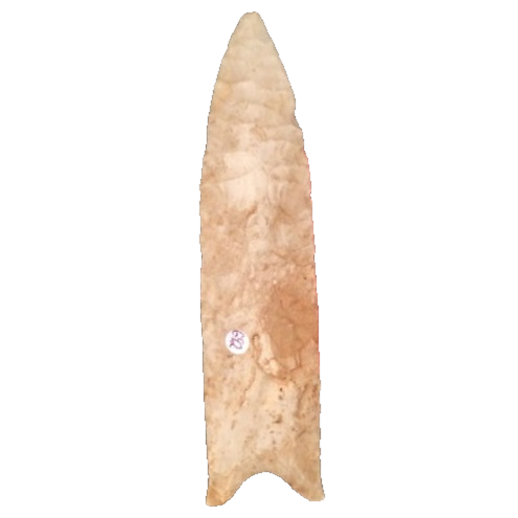
Arrowhead type
Dalton Auriculate Point
Dalton AuriculateDalton Cluster10,500 - 8,500 B.P.Transitional Paleo67 reference photos
Key facts
- Age
- 10,500 - 8,500 B.P.
- Cultural period
- Transitional Paleo
- Culture
- Dalton Culture
- Size
- Medium to Large
- Shape
- Auriculate
- Material
- Chert
- Glacial period
- Early Holocene
More from the Paleo period
Description
This auriculate point exhibits a size range of medium to large, characterized by a cross-sectional profile that can be either elliptical or flattened. Its blade shape is predominantly outwardly recurvate, a result of the constriction at the waist or hafting area, which gives rise to the distinctive auriculate "ears." The blade edge often features serrations, but beveling is notably absent. The degree of constriction at the waist can vary, influencing the overall shape of the point. The base of the point is concave, and evidence of grinding is commonly observed on the hafting area, accompanied by basal grinding and flaking. In some instances, the basal flaking may create an appearance reminiscent of fluting. The flaking pattern on these points can exhibit a range of styles, including oblique transverse, horizontal transverse, collateral, or random patterns, highlighting the variability in their manufacture.
Size
The arrowheads exhibit a range of dimensions, with overall lengths spanning 20 to 120 mm, and averaging between 35 to 55 mm. The width of the blade and base falls within a range of 19 to 35 mm, while the basal concavity measures between 3 to 12 mm.
Distribution
This artifact is predominantly located in the central to southern regions of the Mississippi River basin and extending into the Tennessee River basin. Its presence becomes less frequent in the Ohio River basin and further east into the eastern United States and southeastern Canada. The northern range shown on the map coincides with the typical range of the Hi-Lo artifact. It has been proposed that the Dalton artifact does not actually reach these areas, but rather is represented by a variant of the Hi-Lo artifact
Mainly found in
- Texas
- Oklahoma
- Kansas
- Nebraska
- Iowa
- Missouri
- Arkansas
- Louisiana
- Minnesota
- Wisconsin
- Illinois
- Kentucky
- Tennessee
- Mississippi
- Alabama
- Georgia
- Florida
- South Carolina
- North Carolina
- Virginia
- West Virginia
- Maryland
- Delaware
- Ohio
- Indiana
- Michigan
- Pennsylvania
- New Jersey
- New York
- Connecticut
- Rhode Island
- Massachusetts
- New Hampshire
- Vermont
- Canada
Also found, less often, in
Additional information
The transition from the Paleo to the Archaic periods is marked by a significant shift in the technological and cultural landscape of Native American communities. This transformation is evident in the evolution of projectile points and the introduction of new tools, such as the adz and hafted scrapers, which emerged during this time. Notably, the Meserve point has been considered a western counterpart to the Dalton point, with similarities in overall appearance and re-sharpening techniques. However, research by Goodyear (1982) suggests that Meserve points may actually be Plano Lanceolate points, such as Plainview or Fredrick points, that have undergone re-sharpening using a technique similar to that employed for Dalton points, as noted by Justice (1987).
A closer examination of Dalton points reveals a complex history of use and re-sharpening. According to Morrow (2016), many Dalton points exhibit extensive re-sharpening, which can be attributed to their dual function as hafted knives and saws. Furthermore, the presence of impact fractures on many Dalton points suggests that they were also used as projectile points, highlighting their versatility. The Dalton point represents one of the earliest examples of a projectile point being used for multiple purposes, including as a knife, projectile point, and other tools. This pattern of adaptability and multi-functionality continues into the Early Archaic period, reflecting the resourcefulness and ingenuity of Native American communities during this time.
The re-sharpening techniques used on Dalton points are particularly noteworthy, as they demonstrate a high degree of craftsmanship and technical skill. The ability to re-sharpen and re-use points not only reflects the resource constraints of early Native American communities but also highlights their ability to adapt and innovate in response to changing environmental and cultural contexts. As such, the study of Dalton points and their re-sharpening techniques offers valuable insights into the technological, social, and cultural dynamics of Native American communities during the Paleo to Archaic transition, and underscores the importance of continued research and analysis in this field.
Identified by
- Named by
- Carl H Chapman
- Year
- 1948
- Type site
- Various sites, Cole County, Missouri
Similar types
Types that are easy to confuse with the Dalton Auriculate point.
- Chipola
- Clovis
- Debert
- Fredrick
- Golondrina
- Hardaway
- Holland
- Meserve
- Plainview
- San Patrice
Other types in the Dalton Cluster
- Beaver Lake
- Dalton Breckenridge
- Dalton Colbert
- Dalton Greenbrier
- Dalton Hemphill
- Dalton Hempstead
- Dalton Nuckolls
- Dalton Sloan
- Hi-Lo
- Quad
- Russell Cave