
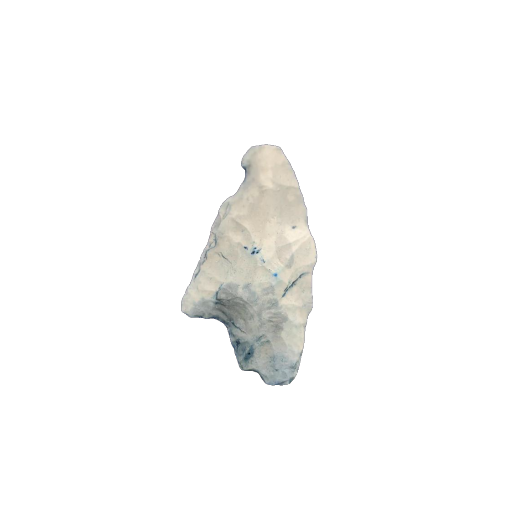
Arrowhead type
Adena Stemmed Point
Adena StemmedAdena Cluster3,500 - 1,300 B.P.Transitional Paleo to Early Archaic39 reference photos
Key facts
- Age
- 3,500 - 1,300 B.P.
- Cultural period
- Transitional Paleo to Early Archaic
- Culture
- Adena Culture
- Size
- Medium to Large
- Shape
- Straight Stem
- Glacial period
- Neoglacial to Roman Warm
Description
This triangular stemmed point exhibits a size range of 1.36 to 6 inches, characterized by a slender, elliptical profile. The elongated blade features an excurvate shape, while the shoulders display a straight to rounded or upward-angled edge. The stem, which is roughly half the width of the blade, is generally broad and straight, although it may exhibit slight expansion or contraction. The base of the point is marked by a convex shape, often without evidence of basal grinding. In terms of manufacture, the point was created using a combination of techniques, including random percussion flaking to shape the overall form, and pressure flaking to refine and retouch the blade, resulting in a random flaking pattern.
Size
The arrowheads exhibit the following dimensional characteristics: their overall length ranges from 50 to 150 mm, with a mean length of 56 to 70 mm. The stem, a crucial component, measures between 15 and 30 mm in length, averaging 21 mm. In terms of width, the blade spans 23 to 43 mm, with an average width of 34 mm. Conversely, the stem width is narrower, ranging from 18 to 27 mm, with a mean stem width of 24 mm. Lastly, the thickness of these arrowheads varies from 7 to 15 mm, with an average thickness of 9 mm.
Distribution
These artifacts are located within the Ohio River Valley region. The typical dispersion of the Adena points is highlighted in red (see Additional Comments). The yellow area represents the sphere of influence and exchange network of the Mound Builders, encompassing the Adena, Hopewell, and Mississippian Cultures.
Mainly found in
Also found, less often, in
Additional information
The Adena Culture is widely regarded as the inaugural phase of the Mound Builder Cultures, a sequence that also encompasses the Hopewell Culture and the Mississippians. Characteristic Adena points, which are predominantly associated with this culture, are typically discovered within the Ohio River Valley. Notably, similar point types are found throughout the broader Mound Builder distribution, exhibiting comparable characteristics to the Adena point. Examples of these analogous points include the Waubesa point, linked to the Hopewell Culture, as well as the Dickson, Mason, and Florence points, which are attributed to the Red Ocher Culture. When encountering Adena-style points outside the Adena cultural sphere, it is essential to assess the possibility that they may represent similar, yet distinct, types.
The origins and dispersal of Adena points are subjects of ongoing interest. Research suggests that early Adena points are most frequently associated with the Tennessee River Valley, from which they appear to have spread during the early Woodland period, as noted by Kneberg in 1956. However, the Adena culture itself is believed to have originated and been centered in the Ohio River Valley, as indicated by reference W11. This highlights the complex dynamics of cultural exchange and migration within the region. The early Woodland period, in particular, was a time of significant cultural and technological development, marked by the emergence of distinctive artifact styles, including the Adena point.
A comparative analysis of Adena and Waubesa points reveals intriguing similarities and differences. While both point types share certain characteristics, they can be distinguished by distinct morphological features. Adena points tend to have less defined shoulders, with the widest part of the blade situated above the shoulder area. In contrast, Waubesa points, as described by Morrow in 2016, are characterized by well-defined shoulders, with the widest part of the blade coinciding with the shoulder area. This subtle yet significant distinction underscores the importance of meticulous typological analysis in understanding the cultural and chronological contexts of these ancient artifacts. By examining the nuances of point morphology, researchers can gain valuable insights into the technological, social, and cultural practices of the Adena and other Mound Builder cultures.
Identified by
- Named by
- William C. Mills
- Year
- 1902
- Type site
- Adena Estate Mound, Ross County, Ohio
Similar types
Types that are easy to confuse with the Adena Stemmed point.
- Boggy Branch Type II
- Burkett
- Cypress Stemmed
- Duncan Island
- Elk River
- Kent
- Koens Crispin
- Kramer
- Hamilton Stemmed
- Hidden Valley
- Lehigh
- Macon
- New Market
- Pontchartrain
- Randolph
Other types in the Adena Cluster
- Adena Blade
- Adena Dickson
- Adena Narrow Stem
- Adena Robbins
- Adena Snapped Base
- Adena Vanishing Stem
- Adena Waubesa
- Cresap
- Fulton
- Turkeytail
- Gary
- Harrison Turkeytail
- Hebron Turkeytail
- Little Bear Creek
- Poplar Island
- Rossville