
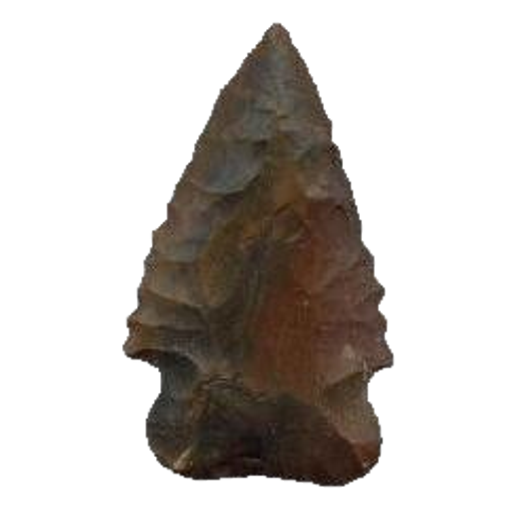
Arrowhead type
Boggy Branch Type II Point
Boggy Branch Type II8,000 - 6,000 B.P.Early Archaic4 reference photos
Key facts
- Age
- 8,000 - 6,000 B.P.
- Cultural period
- Early Archaic
- Size
- Medium to Large
- Shape
- Expanding Stem
- Glacial period
- Middle Holocene
More from the Archaic period
Description
This triangular point, measuring between 2.5 and 4.5 inches in length, exhibits an elliptical cross-sectional profile and features a serrated blade. Initially, the blade edge may display an excurvate shape, but as the point undergoes repeated resharpening, it can transform into an incurvate or recurvate form, characterized by an inward curvature at the tip and an outward flare at the shoulders. Prolonged resharpening also results in the formation of steeply angled edges. The shoulders of this point can vary in morphology, ranging from barbed to upwardly angled, although heavy resharpening tends to reduce their prominence, often yielding weakly defined shoulders. The stem, which can be slightly expanding or more pronouncedly so with a convex base, is distinguished by rounded basal corners, imparting a bulbous appearance. Additionally, evidence of grinding in the hafting region is frequently observed. The flaking pattern on this point is characterized by a random arrangement of flakes.
Size
The arrowheads exhibit a range of dimensions, with overall lengths spanning 40 to 82 mm, and averaging between 50 to 60 mm. The stem section measures between 13 to 22 mm in length, while the blade itself ranges from 20 to 38 mm in width. The stem width varies from 19 to 30 mm, and the overall thickness of the arrowhead is between 7 to 13 mm.
Distribution
This type is mainly located in southern Alabama's eastern region, western Georgia's southern area, and the northern parts of Florida.
Additional information
In the realm of Native American arrowheads, two distinct variants of this particular type have been distinguished by archaeologists. Notably, the first variant, designated as Type 1, is characterized by a stem that is both longer and more rounded in shape. In contrast, the second variant, referred to as Type 2, exhibits a shorter stem with a flattened profile, and is generally smaller in overall size compared to its Type 1 counterpart. It is worth noting that this arrowhead type is believed to be closely related to the Big Slough type point, as suggested by Granger and Granger in their 2013 research. This association underscores the complexities and nuances of arrowhead typology, highlighting the need for careful analysis and classification in understanding the cultural and historical contexts of these artifacts.
Identified by
- Named by
- Ralph Allen Jr.
- Year
- 1989
- Type site
- Boggy Branch Creek, Henry County, Alabama
Similar types
Types that are easy to confuse with the Boggy Branch Type II point.
- Big Slough
- Bolen Beveled
- Kirk Stemmed
- South Prong Creek