
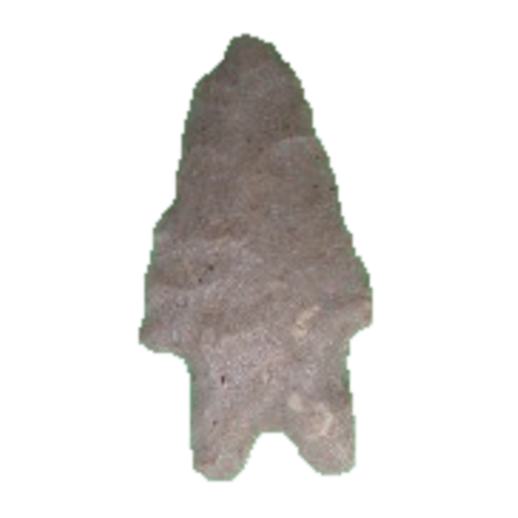
Arrowhead type
Duncan Point
DuncanMcKean Cluster3,700 - 2,500 B.P.Middle Archaic to Late Archaic9 reference photos
Key facts
- Age
- 3,700 - 2,500 B.P.
- Cultural period
- Middle Archaic to Late Archaic
- Size
- Small to Medium
- Shape
- Bifurcated
- Glacial period
- Neoglacial
More from the Archaic period
Description
This lanceolate point exhibits a slender, elongated form, characterized by a cross-sectional profile that is either elliptical or features a pronounced median ridge. The blade itself displays a distinctive excurvate curvature. The shoulder area can be quite subtle, ranging from barely perceptible to more pronounced, with an orientation that may be horizontal or inclined upward. The stem's morphology varies, ranging from a straight configuration to one that expands slightly outward. The base of the point is notable for its concave shape, which can range from a subtle indentation to a more pronounced curvature, accompanied by rounded corners that enhance its overall aerodynamics. The basal and lateral edges, where the point would have been attached to a haft, frequently exhibit evidence of grinding. In terms of its manufacture, this point was initially shaped through percussion flaking, with subsequent refinement achieved via pressure flaking, resulting in a flaking pattern that transitions from collateral to random, underscoring the craftsmanship invested in its creation.
Size
The dimensions of these arrowheads are characterized by a total length ranging from 28 to 59 mm, with a mean length typically falling between 40 to 50 mm. The stem length is generally proportional to the total length, comprising approximately 1/4 to 1/3 of the overall measurement. The blade width varies between 15 to 28 mm, while the thickness ranges from 3 to 7 mm.
Distribution
This projectile is a grassland variant that predominantly occurs on the Northern Prairies. It is most frequently discovered in the Canadian provinces of Saskatchewan and Alberta, and extends into the US states of Montana, the Dakotas, and Wyoming. Occurrence rates decline in Idaho, Utah, Colorado, and Nebraska. It is seldom encountered on the Colorado Plateau, and is absent from the Great Basin region. Morrow (2016) notes that this type is occasionally found in Minnesota and Iowa
Mainly found in
Additional information
In the realm of Native American arrowhead studies, the Duncan and Hanna points are two notable types that have garnered significant attention from archaeologists. Characteristically, the Duncan point is distinguished by its straight to upward-angled shoulder, accompanied by a straight to slightly expanding stem. In contrast, the Hanna point is recognizable by its barbed shoulder and expanding stem. For some time, it has been suggested that these two points may, in fact, represent a continuum of evolution, with some researchers proposing that they be collectively referred to as the Duncan-Hanna point, as advocated by David and Keyser in 1999.
Further examination of these point types has revealed a complex stylistic overlap with other varieties within the McKean complex, including the McKean, Yonkee, and several unnamed point types, as observed by Morrow in 2016. Notably, the Hanna point is often confused with the Yonkee point, highlighting the need for careful analysis and distinction between these similar types. Taylor, in 2006, referred to both the Duncan and Hanna points as McKean Shouldered points, underscoring their shared characteristics. Additionally, the Southsider Var. point type is seen as a transitional form between the McKean and Duncan points, with its classification often depending on the degree of lateral edge restriction, leading some to categorize it as either a McKean or Duncan point, or alternatively, as a Shouldered McKean.
The Duncan point, in particular, has been referred to by multiple names, including the Shouldered McKean, reflecting its distinctive shoulder morphology. This terminological overlap highlights the complexities and nuances of arrowhead classification, where subtle variations in form and style can lead to differing interpretations and categorizations. By examining these point types in detail, researchers can gain a deeper understanding of the cultural and historical contexts in which they were created, as well as the technological and stylistic developments that characterized the evolution of Native American arrowhead production.
Identified by
- Named by
- Richard P. Wheeler
- Year
- 1954
- Type site
- Duncan, Wyoming
Similar types
Types that are easy to confuse with the Duncan point.
- Hanna
- Fredrick
- Gatecliff Split Stem
- Meserve
- Pinto Basin
- San Jose