
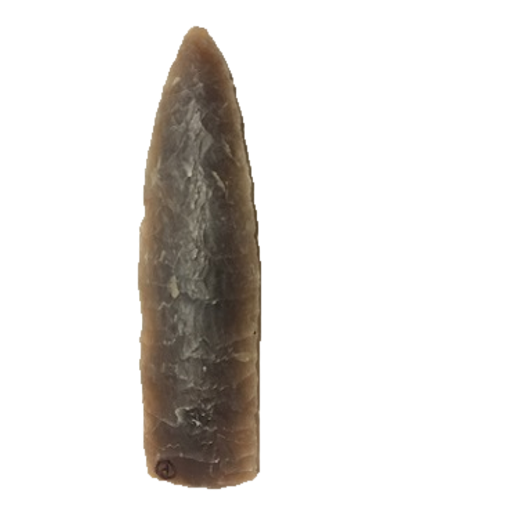
Arrowhead type
Firstview Point
FirstviewPlano Stemmed Cluster9,500 - 8,000 B.P.Transitional Paleo8 reference photos
Key facts
- Age
- 9,500 - 8,000 B.P.
- Cultural period
- Transitional Paleo
- Size
- Medium to Large
- Shape
- Lanceolate
- Material
- Agate
- Glacial period
- Early Holocene
More from the Paleo period
Description
This lanceolate point exhibits a size range from medium to large, characterized by an elliptical profile. A distinctive median ridge is present on some specimens, adding to the point's visual complexity. The blade itself displays an excurvate shape, where the edges curve outward towards the tip, while maintaining parallelism along the majority of its length. The shoulders are either subdued or entirely absent, transitioning into a straight stem that is often defined by intense grinding in the hafting area, which subtly suggests a stemmed morphology. The base of the point is predominantly straight, occasionally featuring a slight indentation, and typically assumes a wedge-like shape. In terms of flaking patterns, these points can display a range of techniques, including collateral, parallel, and oblique flaking, underscoring the variability in their manufacture.
Size
The dimensions of the arrowheads are characterized by the following measurements: overall length ranges from 35 to 110 mm, with a typical average span of 55 to 75 mm. The stem portion measures between 12 to 21 mm in length, with a mean length of 15 mm. The blade itself exhibits a width of 20 to 30 mm, while the stem is consistently 0 to 3 mm narrower than the blade width.
Distribution
This type is predominantly linked to the Great Plains region, spanning from Texas to Canada. It can also be discovered from the western Great Basin to the central Mississippi River valley area
Mainly found in
Additional information
The classification of this particular arrowhead point has undergone significant reevaluation. Initially, it was misidentified as a variant of the Scottsbluff type, a categorization that stemmed from George Agogino's 1964 discovery of a similar point. At the time, Agogino was not familiar with the distinct characteristics of the Firstview type, which this point actually embodies. Notably, the initial radiocarbon dating of this point yielded an age of 10,200 years, suggesting it predated the Cody Complex points. However, this date has been called into question due to potential contamination from bison hoof dirt, prompting further investigation.
Subsequent radiocarbon dating has produced results that align this point with the chronological framework of the Cody Complex, highlighting the complexities of accurately dating these archaeological artifacts. The site at Blackwater Draw has also yielded valuable insights, with a specific level containing a concentration of Milnesand and Plainview points found in association with Firstview points. This discovery, documented by George Agogino and Matthew H. Hillsman in 1988, raises intriguing questions about the potential antiquity of the Firstview type relative to the Cody Complex. The co-occurrence of these point types at Blackwater Draw underscores the need for continued research and refinement of our understanding of the cultural and chronological contexts in which they were produced.
The Firstview type, as exemplified by this point, exhibits a unique combination of characteristics that distinguish it from other types, such as the Scottsbluff variant. While the initial dating may have sparked debate, the cumulative evidence from radiocarbon dating and stratigraphic analysis at sites like Blackwater Draw contributes to a more nuanced understanding of the Firstview type's place within the broader narrative of Native American archaeological history. As our knowledge of these ancient cultures continues to evolve, the study of arrowhead points like this one remains essential for reconstructing the lives and traditions of the people who created them.
Identified by
- Named by
- Joe Ben Wheat and George Agogino
- Year
- 1972
- Type site
- Olsen-Chubbuck Bison Kill Site, Cheyenne County, Colorado
Similar types
Types that are easy to confuse with the Firstview point.