
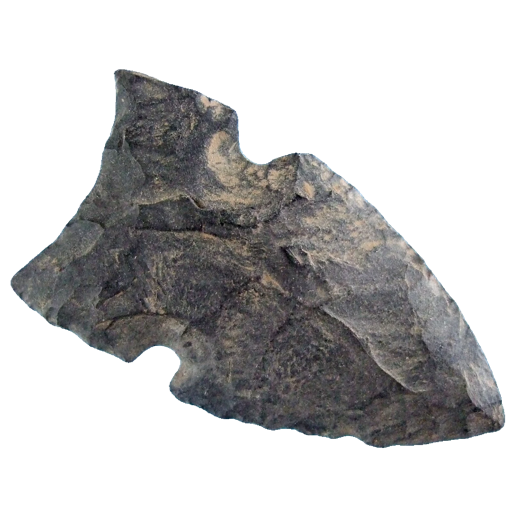
Arrowhead type
Mallory Point
MalloryMcKean Cluster4,500 -3,500 B.P.Middle Archaic7 reference photos
Key facts
- Age
- 4,500 -3,500 B.P.
- Cultural period
- Middle Archaic
- Size
- Small to Medium
- Shape
- Side Notch to Bifurcated
- Glacial period
- Neoglacial
More from the Archaic period
Description
This triangular point exhibits a slender profile, characterized by a medium thickness and an elliptical cross-section that converges to a median ridge. The blade itself is notably broad, displaying a range of curvature from excurvate to straight. Distinctive deep notches are present, positioned higher up on the blade, which contributes to an expansive basal area. The shoulders are oriented horizontally, merging with an expanded stem. The edges of the basal ears can be either straight or tapered inward. The base of the point varies in shape, sometimes presenting a concave curvature, a basal notch, or a combination of both. A common feature among these points is the presence of sharp, well-defined basal ears. The flaking pattern observed on these points can be either collateral, indicating a more organized removal of flakes, or random, suggesting a less systematic approach to flake removal.
Size
The dimensions of the arrowheads are as follows: they range in overall length from 30 to 66 mm, with an average length of 40 to 50 mm. The stem length, measured to the junction of the blade and shoulder, varies between 13 and 23 mm. The width of the blade spans 17 to 30 mm, while the neck width measures between 12 and 18 mm. The depth of the notch is recorded at 3 to 5 mm. Additionally, the stem width is consistent with the blade width, ranging from 17 to 30 mm. The basal concavity is observed to be between 3 and 87 mm.
Distribution
This specimen is a characteristic prairie projectile that predominantly occurs in the Northern Grasslands. It is most frequently discovered in Canada, with sightings extending into Idaho, Utah, Colorado, and Nebraska. It is sporadically encountered on the Colorado Plateau, and is absent from the Great Basin region
Mainly found in
Also found, less often, in
Additional information
The archaeological complex in question is characterized by a diverse array of projectile point styles, totaling five primary forms with two variant types. Notable examples include the McKean, Duncan, Southsider, Hanna, and Yonkee points, each with distinct morphological features. A key characteristic of these points is their similarity to the Northern Side Notch type, with the notable exception of a higher notch placement on the blade, resulting in an expanded hafting area. This design adaptation likely facilitated a more secure attachment to the shaft, enhancing overall functionality.
The Southsider variant is particularly noteworthy, as it represents a transitional form between the McKean and Duncan points. This intermediate type often poses classification challenges, as its morphology can be seen as a continuum between the two parent styles. Consequently, the Southsider variant is frequently typed as either a McKean or Duncan point, depending on the degree of lateral edge restriction exhibited. This phenomenon highlights the complexities of projectile point typology and the need for nuanced analysis. Interestingly, the Southsider variant is also referred to as the Shouldered McKean, a designation that reflects its shared characteristics with the McKean point.
The Duncan point, another significant component of this complex, is also sometimes referred to as the Shouldered McKean, underscoring the close relationship between these two point styles. This overlap in nomenclature serves as a reminder of the intricate and often subtle variations that exist within projectile point typologies. By examining these points in detail, researchers can gain valuable insights into the technological, cultural, and historical contexts in which they were created and used, ultimately enriching our understanding of the lives and traditions of the Native American communities that crafted them.
Identified by
- Named by
- William D. Strong
- Year
- 1965
- Type site
- Signal Butte, Scotts Bluff County, Nebraska
Similar types
Types that are easy to confuse with the Mallory point.
- Avonlea Gulf Lake
- Besant
- Billings
- Bitterroot
- Cut Bank
- Emigrant
- Irvine
- Logan Creek
- Lookingbill
- Northern Side Notch
- Nanton
- Samantha
- San Rafael