
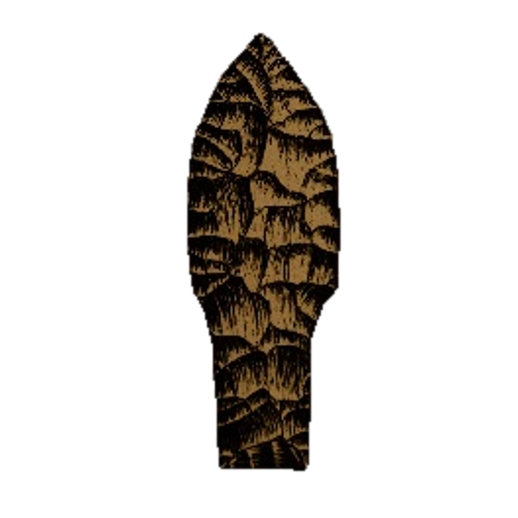
Arrowhead type
Rio Grande Point
Rio GrandeBajada Cluster to Escobas Cluster7,000 - 6,000 B.P.Middle Archaic4 reference photos
Key facts
- Age
- 7,000 - 6,000 B.P.
- Cultural period
- Middle Archaic
- Size
- Medium to Large
- Shape
- Contracting Stem to Straight Stem to Lanceolate
- Material
- Agate
- Glacial period
- Middle Holocene
More from the Archaic period
Description
This lanceolate point exhibits a distinctive morphology, characterized by a medium to large size and an elliptical cross-sectional profile. The blade's curvature is predominantly excurvate, although some specimens may display a straight configuration, with the maximum width typically occurring just above the midpoint. The shoulders are either faint or nonexistent, and when present, they slope upward at a pronounced angle. The stem's orientation can vary from straight to slightly tapering, and its length is often comparable to, or even exceeds, that of the blade. The basal edge ranges from straight to concave, and while the stem's edges exhibit extensive grinding and smoothing, the base may show only minimal or no grinding, frequently accompanied by basal thinning. The point's fabrication involves direct percussion flaking, supplemented by secondary pressure flaking along the edges, resulting in a random, irregular flaking pattern.
Size
The dimensions of the arrowheads are as follows: they typically range in overall length from 45 to 70 mm, with an average length of 60 mm. The stem width varies between 15 and 23 mm, while the blade width measures between 20 and 30 mm, averaging 28 mm. Additionally, the basal width is recorded to be between 11 and 18 mm.
Distribution
Mainly located in the Rio Grande region and extending into the San Luis valley in Colorado.
Additional information
In the realm of Native American archaeology, the evolution of arrowhead styles provides valuable insights into the cultural and technological developments of various societies. Notably, the Quemado phase is believed to have given rise to the San Jose phase, marking a significant transition in the archaeological record. A key artifact associated with this transition is a distinctive type of arrowhead that exhibits a clear lineage from the Jay point style. Over time, this point type further evolved into the characteristic Escobas points, demonstrating a continuous process of innovation and refinement.
A crucial aspect of identifying and distinguishing between different arrowhead styles lies in their morphological characteristics. In this context, the shoulders of the point are a diagnostic feature that can be used to differentiate between related styles. For instance, when comparing this particular point type to the Hell Gap point, it becomes apparent that the latter possesses more developed shoulders. This subtle yet significant distinction highlights the importance of meticulous observation and analysis in archaeological classification.
The study of these arrowhead styles not only sheds light on the technological and cultural advancements of Native American societies but also underscores the complexities of their evolutionary trajectories. By examining the developmental pathways of these point types, researchers can gain a deeper understanding of the historical contexts in which they were created and used. Ultimately, this knowledge contributes to a more nuanced appreciation of the rich cultural heritage and traditions of Native American communities, while also informing our broader understanding of human technological and social development.
Identified by
- Named by
- Kenneth Honea
- Type site
- La Bolsa Site, Central New Mexico
Similar types
Types that are easy to confuse with the Rio Grande point.