
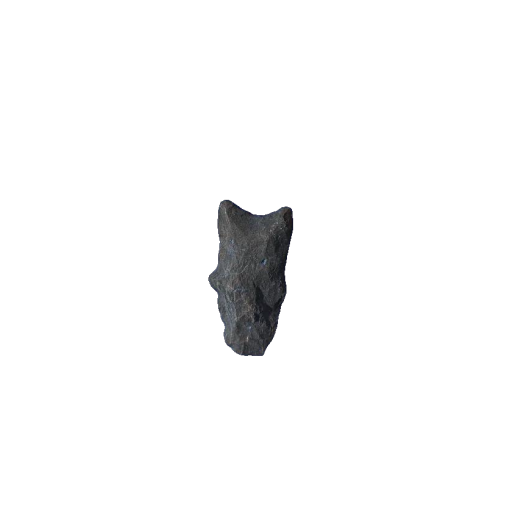
Arrowhead type
Bajada Point
BajadaBajada Cluster6,800 - 5,300 B.P.Middle Archaic13 reference photos
Key facts
- Age
- 6,800 - 5,300 B.P.
- Cultural period
- Middle Archaic
- Culture
- Oshara Tradition
- Size
- Medium to Large
- Shape
- Straight Stem to Expanding Stem
- Material
- Obsidian
- Glacial period
- Middle Holocene
More from the Archaic period
Description
This lanceolate point exhibits a medium to large size, characterized by a stem and a distinctive elliptical to diamond-shaped cross-sectional profile. The blade's curvature ranges from pronounced excurvate to nearly straight, while the shoulder's orientation can vary, appearing either horizontal, angled upward, or in some cases, weakly defined or absent. The stem is notably long and predominantly straight, although it may subtly flare outward toward the ears. The base of the point is concave or bifurcated, often thinned, and displays evidence of basal and hafting region grinding. The manufacturing technique employed involves percussion flaking, supplemented by pressure flaking to achieve a high-quality finish, resulting in a random flaking pattern. Notably, the flaking is typically fine and of exceptional quality, with serrations being a rare occurrence on this point type.
Size
The dimensions of the arrowheads are characterized by the following measurements: overall length ranges from 42 to 77 mm, with a mean length typically falling between 35 to 45 mm. The stem length varies from 9 to 23 mm, averaging between 17 to 19 mm, and exhibits a typical stem-to-blade ratio of 1:1.9. The blade width spans 16 to 28 mm, with an average width of 18 to 20 mm. At the shoulders, the stem width measures between 11 to 20 mm, while the basal width ranges from 11 to 19 mm. The thickness of the arrowheads is between 5 to 10 mm.
Distribution
This projectile is mainly located throughout the Colorado River Basin, San Juan River basin and extending up into the Moab region. This projectile may be encountered less often across the Colorado Plateau, the Uncompahgre Plateau, and into the Great Basin
Additional information
In the realm of Native American arrowheads, the Bajada point exhibits notable similarities to the Jay point, albeit with distinct characteristics. One of its defining features is the basal concavity, which is accompanied by basal thinning, resulting in a smaller and more widespread point. Notably, the Bajada point differs from similar types, such as the Pinto and San Jose points, in that it has a longer stem. Interestingly, some specimens of the Bajada point display a single shoulder, leading researchers to consider them as variants of the Sandia point, as observed by Justice in 2002.
The Bajada point is a significant type that encompasses the characteristics of two previously defined types: the Rio Grande and the Escobas points. Initially, the Rio Grande point had a broad definition, but subsequent research has led to its subdivision into four distinct types: the Bajada, San Jose, Jay, and Escobas points, as noted by Justice in 2002. This reclassification has enabled a more nuanced understanding of the characteristics that distinguish each type. For instance, the Escobas point can be differentiated from the Bajada point by its subtle incurvate lateral edge of the stem, a feature that sets it apart from its counterparts.
The Bajada point's unique combination of characteristics, including its basal concavity and longer stem, makes it an important type for archaeologists studying Native American arrowheads. Its relationship to other point types, such as the Jay, Pinto, and San Jose points, highlights the complexity and diversity of arrowhead designs in Native American cultures. By examining the characteristics of the Bajada point and its variants, researchers can gain a deeper understanding of the technological, cultural, and historical contexts in which these arrowheads were created and used.
Identified by
- Named by
- Cynthia Irwin-Williams
- Year
- 1973
Similar types
Types that are easy to confuse with the Bajada point.