
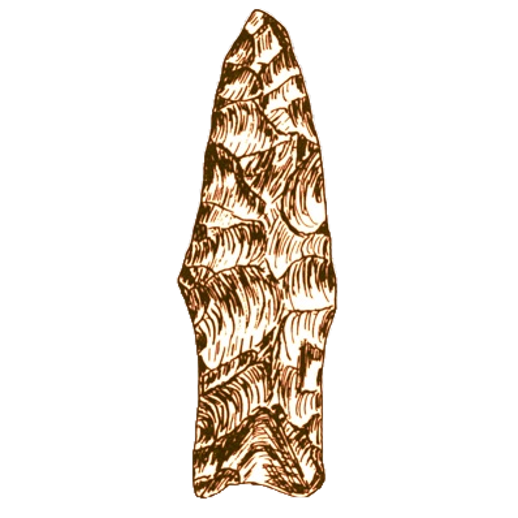
Arrowhead type
Escobas Point
EscobasBajada Cluster6,500 - 6,200 B.P.Middle Archaic3 reference photos
Key facts
- Age
- 6,500 - 6,200 B.P.
- Cultural period
- Middle Archaic
- Size
- Medium
- Shape
- Lanceolate to Straight Stem
- Material
- Basalt
- Glacial period
- Middle Holocene
More from the Archaic period
Description
This lanceolate point exhibits a robust, medium-stemmed profile, characterized by an elliptical to median ridge cross-sectional morphology. The blade's curvature is pronounced, with its maximum width situated just beneath the midpoint, lending an excurvate silhouette. The shoulder regions are either subtly defined or virtually absent, often presenting a gently rounded or upwardly angled contour. The stem, which comprises approximately one-half to one-third of the point's overall length, may display a straight or slightly flared configuration. A distinctive concave curvature defines the base. Notably, the lateral edges of the stem often bear evidence of grinding, whereas the base typically does not. The point's manufacture involves predominantly percussion flaking, with pressure flaking making only rare appearances on the blade. In contrast, the stem features finer, more delicate flaking, executed through a combination of percussion and pressure techniques, resulting in a random, non-patterned flaking arrangement.
Size
The arrowheads exhibit the following dimensional characteristics: overall length ranges from 36 to 71 mm, with a mean length of 60 mm. The stem length varies between 17 and 35 mm, generally accounting for one-third to one-half or more of the total length. The maximum blade width, measured at the shoulders, falls within the range of 18 to 26 mm, averaging 20 mm. Additionally, the basal width spans from 13 to 19 mm, with an average measurement of 17 mm.
Distribution
This type is mainly discovered in the northern Rio Grande region of New Mexico, southern parts of Colorado, and extending into northeast Arizona. This type may also be discovered in the Rio Grande Valley area of Texas.
Mainly found in
Also found, less often, in
Additional information
The evolution of Native American arrowhead types is a complex and fascinating topic, with various forms emerging over time. Notably, the point in question is believed to have originated from the Rio Grande type, marking a significant milestone in the development of projectile points. This transitional phase is characterized by distinct morphological features that would eventually give rise to the Bajada type, highlighting the dynamic nature of technological innovation among ancient cultures. By examining the characteristics of this point, researchers can gain valuable insights into the technological and cultural exchanges that occurred between different Native American groups, ultimately shedding light on the intricate relationships between various archaeological types.
The connection between the Rio Grande and Bajada types, with this point serving as a precursor to the latter, underscores the importance of understanding the chronological and geographical context of arrowhead development. This sequence of events not only demonstrates the gradual refinement of stone tool manufacturing techniques but also reflects the adaptability and resourcefulness of Native American communities in response to their environments. As archaeologists continue to study the nuances of these point types, they are able to reconstruct a more detailed narrative of the cultural and technological trajectories that defined the lives of ancient Native American peoples.
Through the analysis of this point and its position within the broader context of arrowhead evolution, researchers can appreciate the remarkable complexity and diversity of Native American technological and cultural heritage. The fact that this point represents a transitional phase between the Rio Grande and Bajada types serves as a testament to the dynamic and ever-changing nature of human innovation, highlighting the significance of continued archaeological research into the history and development of Native American cultures.
Identified by
- Named by
- Kenneth Honea
- Year
- 1965
Similar types
Types that are easy to confuse with the Escobas point.