
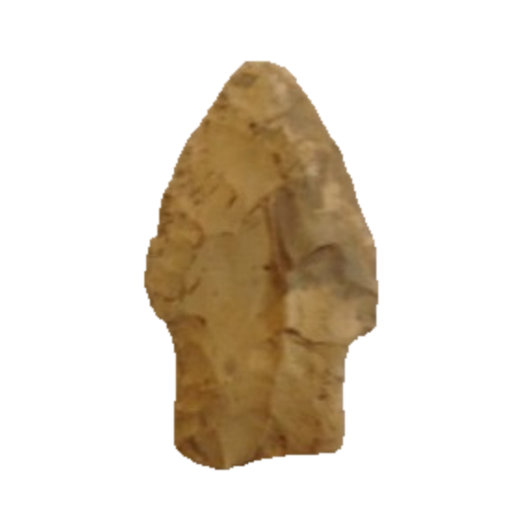
Arrowhead type
Cherokee Point
Cherokee9,000 - 8,000 B.P.Erly Archaic2 reference photos
Key facts
- Age
- 9,000 - 8,000 B.P.
- Cultural period
- Erly Archaic
- Size
- Small to Medium
- Shape
- Contracting Stem to Straight Stem
- Glacial period
- Early Holocene
More from the Archaic period
Description
This medium-sized, lanceolate point features a stemmed design with an elliptical cross-sectional profile. The blade exhibits a predominantly excurvate shape, although specimens with subdued shoulders can create a recurvate illusion. The blade's maximum width is situated just above the shoulder area, which typically spans between one-half to one-quarter of the point's overall length. Characteristically, the shoulders are faint or absent, sloping upward at a gentle angle. The stem is notably long, often displaying a slightly contracting or straight configuration. The base of the point is generally straight, with occasional variations ranging from slightly concave to convex. A common feature of this point is the presence of basal grinding. The flaking pattern on the point can exhibit a range of styles, from random and unorganized to more structured parallel or horizontal transverse arrangements.
Size
Small to Medium
Distribution
This type is mainly located in the western region of Iowa.
Mainly found in
Additional information
In his 1984 analysis, Morrow categorized this particular arrowhead as a regional variation of the Hell Gap type, distinguished by its unique characteristics. Notably, this specimen exhibits a smaller size and slightly less refined craftsmanship compared to the traditional Hell Gap point, suggesting a potential adaptation to local materials or manufacturing techniques. This subtle distinction highlights the diversity within arrowhead typologies and underscores the importance of considering regional variations when interpreting the archaeological record.
The Hell Gap type, characterized by its distinctive morphology, is a well-established category in the study of Native American arrowheads. The fact that this specimen is identified as a local variant underscores the complexity of cultural exchange and technological diffusion among prehistoric societies. By examining the nuances of arrowhead design and manufacture, researchers can gain valuable insights into the social, economic, and environmental contexts in which these artifacts were created and used.
The smaller size and slightly cruder construction of this arrowhead, relative to the standard Hell Gap point, may indicate a specific functional or cultural significance that warrants further investigation. As archaeologists continue to refine our understanding of Native American technological and cultural developments, the study of arrowheads like this one offers a unique window into the lives and traditions of prehistoric communities, highlighting the importance of meticulous analysis and contextualization in uncovering the stories behind these ancient artifacts.
Identified by
- Named by
- Toby Morrows
- Year
- 1984
- Type site
- Cherokee Sewer Site, Cherokee County, Iowa
Similar types
Types that are easy to confuse with the Cherokee point.