
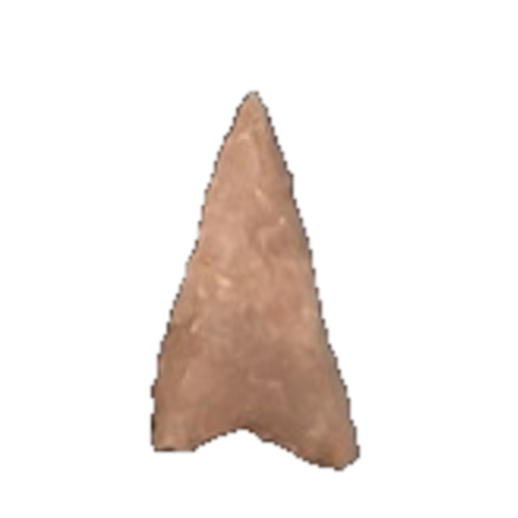
Arrowhead type
Fresno Point
FresnoLate Southern Triangle Cluster1,200 - 250 B.P.Historic to Mississippian16 reference photos
Key facts
- Age
- 1,200 - 250 B.P.
- Cultural period
- Historic to Mississippian
- Size
- Small
- Shape
- Triangle to Lanceolate
- Glacial period
- Vandal Minimum to Little Ice Age
More from the Mississippian, Historic periods
Description
This triangular point exhibits a slender profile with a compressed cross-sectional morphology. The blade edge is generally linear, although occasional specimens display an excurvate or, more rarely, an incurvate curvature. Serrations are uncommon, but when present, they can be quite pronounced. The point's shape typically conforms to an isosceles triangle, with a width roughly half its height, while some examples approach an equilateral triangle, where the width and height are approximately equal. The base of the point is usually straight or slightly concave, often featuring basal thinning. The manufacturing technique is often crude, with many specimens showing a large, smooth fracture scar on the face, indicative of a flake removal process that prioritizes edge trimming over facial flaking. The point is typically fashioned from a flake using pressure flaking, resulting in a random, irregular flaking pattern.
Size
The arrowheads exhibit dimensions ranging from 20 to 35 mm in overall length, with widths spanning 10 to 20 mm, and thicknesses varying between 2 and 6 mm.
Distribution
This arrowhead type predominantly occurs in southern Texas, extending into Chihuahua, Coahuila, Nuevo Leon, and Tamaulipas, and reaching central Texas. It occasionally appears in eastern Texas and western Louisiana, as well as the Red River valley. Sightings have also been documented in the Tehuacan Valley, Cueva de la Nopalera, Hidalgo, Mexico. The distribution spans the entirety of the Valley of Mexico
Additional information
The Fresno arrowhead type has a rich history of discovery and classification. Initially described by Alex Krieger in 1946, this point was first identified through examples unearthed at the Harrell Site in Young County, Texas. Subsequent discoveries at the Lehmann Rock Shelter led J. Kelly to assign a name to this point type. Meanwhile, Jon Ben Wheat's 1953 survey of the Addicks Dam area in Texas yielded similar points, which he termed "Kobs Triangular." W.W. Taylor later referred to these points as "El Muerto" in his 1966 publication. However, Suhm and Krieger's research led them to consolidate these various designations under the umbrella of the Fresno type.
Notably, the Fresno type exhibits similarities with other point types, such as the Cameron point. A key distinguishing feature between the two is size: while Cameron points never exceed 17 mm in length, Fresno points typically measure 20 mm or more (Moore, 2015). This size-based distinction was also employed by Hester in his 1969 study, where he analyzed a sample of 36 Fresno/Cameron points. Despite searching for consistent morphological patterns, Hester found none, leading him to propose that the size-based classification might be somewhat arbitrary. He suggested that points under 20 mm could be considered Cameron, while those exceeding 20 mm could be classified as Fresno. Hester's research raises the intriguing possibility that these two categories might, in fact, represent a single point type.
In terms of geographic distribution, Fresno points have been found in northeastern Texas, as well as in neighboring regions of Oklahoma, Arkansas, and Louisiana. Points discovered in northeastern Texas may also be considered for the Turney type, while higher-quality specimens from this area and beyond might be classified as Talco points. Additionally, deeply concave points in this region could be characterized as Starr points, as noted by Suhm and Krieger in 1954. The Fresno type's complex classification history and subtle variations underscore the importance of careful analysis and consideration of multiple factors in the study of Native American arrowheads.
Identified by
- Named by
- J. Charles Kelly
- Year
- 1947
- Type site
- Lehmann Rock Shelter, Texas
Similar types
Types that are easy to confuse with the Fresno point.
- Cameron
- Camp Creek
- Cottonwood
- Guerrero
- Sand Mountain
- Starr
- Talco
- Tortugas
- Turney