
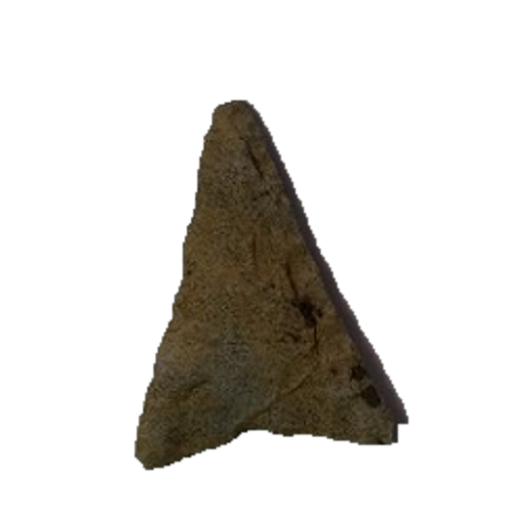
Arrowhead type
Levanna Point
LevannaLate Woodland Triangle Cluster to Early Mississippian Triangle Cluster1,300 - 600 B.P.Mississippian19 reference photos
Key facts
- Age
- 1,300 - 600 B.P.
- Cultural period
- Mississippian
- Size
- Small to Medium
- Shape
- Triangle
- Material
- Jasper
- Glacial period
- Vandal Minimum to Medieval Warm
More from the Mississippian period
Description
This triangular point exhibits a compact, medium-sized profile with a broad outline. In cross-section, the point's thickness can yield a range of shapes, from a flattened profile to a more elliptical form. The blade edge is generally straight, forming a triangular shape that can vary between an equilateral configuration, where the width and height are roughly equivalent, and an isosceles configuration, where the width is approximately half the height. The base of the point typically displays a concave or deeply concave curvature, although some specimens may have a nearly straight base. The flaking pattern observed on this point is characterized by a random, non-directional arrangement of flake scars.
Size
The arrowheads exhibit a range of dimensions, with lengths spanning 22 to 75 mm, widths varying from 32 to 44 mm, and thicknesses measuring between 8 and 10 mm.
Distribution
This type is mainly discovered in the Northeastern United States and extends into southeastern Canada and may also appear in parts of the Mid-Atlantic region
Additional information
In the realm of Native American archaeology, a particular arrowhead has garnered attention for its distinctive characteristics and chronological significance. Notably, this point is larger and older than many of its counterparts within the same cluster, suggesting it may have been superseded by the Madison point over time. A compelling argument has been made by researchers that the Yadkin point and the Levanna point are, in fact, the same type, albeit with differing geographical distributions. The Levanna point is predominantly found in areas ranging from northern Virginia and extending northward, whereas the Yadkin point is typically discovered in regions spanning from southern Virginia southward.
A closer examination of the morphological characteristics of these two points reveals striking similarities, lending credence to the notion that they are, indeed, the same type. However, discrepancies arise when attempting to date these points. The Levanna point has been dated to a range of 700 A.D. to 1,350 A.D., based on research conducted by Richie (1971) and Kinskey (1972). In contrast, the Yadkin point has been dated to a significantly earlier period, spanning from 300 B.C. to 800 A.D., as determined by radiocarbon dating of associated Yadkin ceramics (UNC). This notable difference in dating may be attributed to variations in the methodologies employed or could indicate a gradual shift in the usage of this point type from southern regions to northern areas over time.
The coexistence of these two points, with their shared characteristics yet distinct distributions, presents a fascinating case study in the evolution of Native American arrowhead technology. Further research is warranted to fully elucidate the relationship between the Yadkin and Levanna points, as well as to clarify the factors contributing to the observed discrepancies in their dating. Nevertheless, the available data underscore the complexity and nuance of Native American cultural and technological developments, highlighting the need for continued archaeological investigation and analysis to deepen our understanding of these enigmatic artifacts.
Identified by
- Named by
- William A Richie
- Year
- 1961
- Type site
- Levanna Site, Cayuga County, New York
Similar types
Types that are easy to confuse with the Levanna point.
- Camp Creek
- Sand Mountain
- Yadkin