
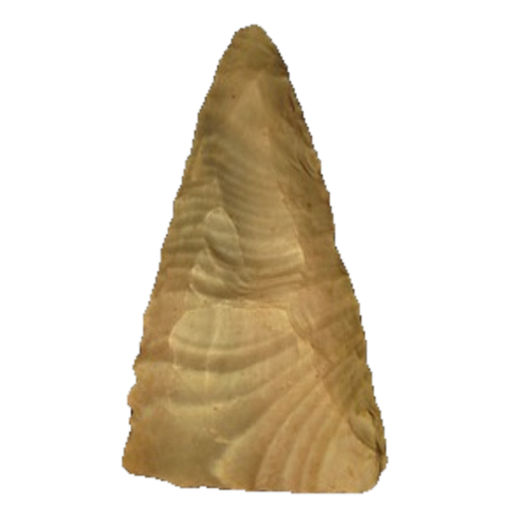
Arrowhead type
Tortugas Point
Tortugas4,500 - 2,600 B.P.Middle Archaic to Late Archaic20 reference photos
Key facts
- Age
- 4,500 - 2,600 B.P.
- Cultural period
- Middle Archaic to Late Archaic
- Size
- Medium to Large
- Shape
- Triangle
- Material
- Pottery
- Glacial period
- Neoglacial
More from the Archaic period
Description
This triangular point exhibits a robust profile, typically measuring between 2 inches in length, with a cross-sectional shape that is elliptical in outline. The blade's curvature can range from straight to subtly convex, while its edges often display a distinctive beveling pattern, most frequently observed on the right edge, where alternating edges are beveled. The central portion of the point typically features coarse, irregular flaking. The base of the point can vary in shape, ranging from a straight line to a gentle concavity, and is often carefully thinned through the removal of short, longitudinal flakes, which can create a fluted appearance. The lower segment of the blade, spanning approximately 10 to 35 mm, frequently shows evidence of grinding, along with the basal edge. The manufacturing process involves an initial stage of primary percussion flaking, followed by controlled percussion flaking or pressure flaking to shape and refine the edges, resulting in a beveled edge and a flaking pattern characterized by random, overlapping scars.
Size
The length of the blade that is typically subjected to grinding, in conjunction with the basal edge, ranges from 10 mm to 35 mm.
Distribution
This arrowhead type is mainly discovered in the Trans Pecos area, spanning the Rio Grande River valley and extending into the Gulf Coast areas of Texas and Tamaulipas. The occurrence of this type dwindles in central Texas and beyond the Rio Grande Valley into Mexico. Discoveries have been made at Santa Marta Cave in Chiapas, Tecolote Cave in Hidalgo, Cueva de la Nopaler a, Michoacan and Guerrero, with surface discoveries in southern Tamaulipas, Tehuacan Valley and the Valley of Mexico. MacNeish (1967) observes that they are typically absent in western and northwestern Mexico.
Additional information
In 1947, archaeologist Kelly identified three distinct point types: the Baird Beveled Blade, Taylor Thinned Blade, and Tortugas Triangular Blade. However, subsequent research by Krieger and Newell at the Davis site in eastern Texas led to the application of the Baird and Taylor names to similar specimens. A more in-depth analysis conducted by Suhm and Krieger in 1954 revealed that the differences between these three types were not as pronounced as initially thought. As a result, they consolidated the three categories into a single type, opting to retain the name "Tortugas" due to its association with points commonly found in southwestern Texas.
Notably, the Tortugas point bears a resemblance to the smaller Matamoros point, with the primary distinction being size. Matamoros points typically range from 20 to 40 mm in length, whereas Tortugas points span from 40 to 80 mm. The classification of these points can be nuanced, as larger Matamoros specimens with atypical widths may be categorized as Tortugas, and conversely, smaller Tortugas points with narrower widths may be classified as Matamoros. This size-based distinction highlights the complexity of point typology and the need for careful consideration of morphological characteristics.
The Tortugas point is also significant in its cultural and chronological context. Along with the Abasolo point, it represents a larger, older point type, whereas the Matamoros and Catan points are smaller and more recent. A key difference between these point types is their association with other archaeological materials: Matamoros and Catan points are often found in conjunction with pottery, whereas Tortugas and Abasolo points are not. This dichotomy suggests distinct cultural and temporal affiliations, underscoring the importance of careful analysis and consideration of point typology in reconstructing the lives and traditions of ancient Native American communities.
Identified by
- Year
- 1947
- Type site
- Southwest Texas
Similar types
Types that are easy to confuse with the Tortugas point.