
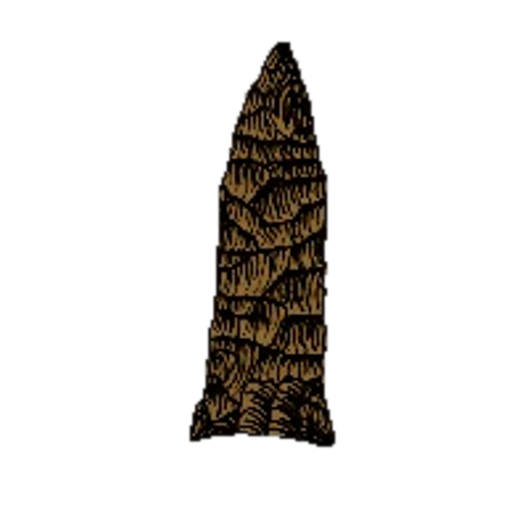
Arrowhead type
Talco Point
TalcoLate Southern Triangle Cluster500 - 200 B.P.Late Prehistoric to Historic to Mississippian9 reference photos
Key facts
- Age
- 500 - 200 B.P.
- Cultural period
- Late Prehistoric to Historic to Mississippian
- Culture
- Caddo Culture
- Size
- Small to Medium
- Shape
- Triangle to Lanceolate
- Material
- Pottery
- Glacial period
- Little Ice Age
More from the Mississippian, Late Prehistoric, Historic periods
Description
This triangular point exhibits a slender profile, typically ranging from straight to recurvate, with some instances displaying an excurvate curvature. The cross-section is characterized by a flattened, elliptical shape, yielding a thin and compact form. Notable features include a finely serrated edge, which is a common trait among these points, and a distinctive tip that often inclines inwardly, serving as a distinguishing characteristic. In specimens with a recurvate blade, the edges may converge to become nearly parallel, before flaring outward at the base, which is typically concave in shape. The overall craftsmanship of these points is often refined, with a random flaking pattern evident on the surface, underscoring the skillful technique employed in their creation.
Size
The arrowheads exhibit a range of dimensions, with overall lengths spanning 20 to 35 mm and widths varying between 10 to 20 mm.
Distribution
This type is mainly discovered in the upper watercourses of the Sabine and Sulphur rivers, extending into the Red River Valley of northeast Texas, and onward into southwest Arkansas, southeast Oklahoma, and northwest Louisiana, often linked to locations of Caddo archaeological significance.
Additional information
In the realm of Native American arrowheads, a distinct category of points can be identified by their characteristic smooth facial surface, which is a remnant of the original flake from which they were crafted. These particular specimens are commonly referred to as Fresno points, named after their association with the Fresno region. The presence of a smooth face on these points is a notable diagnostic feature, allowing archaeologists to categorize and distinguish them from other types of arrowheads. This characteristic is a result of the manufacturing process, where the point was fashioned from a flake that retained its original surface, resulting in a smooth, unscarred face.
The identification of Fresno points is significant, as it provides valuable insights into the technological and cultural practices of the Native American groups that created them. By analyzing the morphology and characteristics of these points, researchers can gain a deeper understanding of the tools and techniques used by these ancient cultures, as well as their geographic distribution and temporal context. The study of Fresno points, therefore, contributes to a broader understanding of Native American archaeology, shedding light on the lives and traditions of the people who crafted these intricate and functional artifacts.
The recognition of Fresno points as a distinct category highlights the importance of meticulous observation and detailed analysis in archaeological research. By examining the subtle characteristics of these points, such as the smooth facial surface, archaeologists can reconstruct the history and cultural context of Native American communities, ultimately enriching our understanding of the complex and diverse societies that flourished in North America. As a result, the study of Fresno points serves as a testament to the significance of archaeological inquiry, demonstrating the value of careful observation and rigorous analysis in uncovering the secrets of the past.
Identified by
- Named by
- Dee Ann Suhm
- Year
- 1954
Similar types
Types that are easy to confuse with the Talco point.