
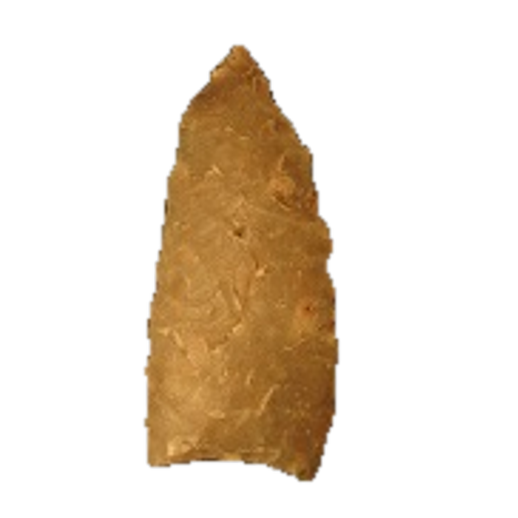
Arrowhead type
Guerrero Point
GuerreroLate Southern Triangle Cluster300 - 150 B.P.HistoricKey facts
- Age
- 300 - 150 B.P.
- Cultural period
- Historic
- Culture
- Coahuiltecan Culture
- Size
- Small to Medium
- Shape
- Triangle to Lanceolate
- Material
- Glass
- Glacial period
- Little Ice Age
More from the Historic period
Description
This triangular point exhibits a slender profile, measuring between small to medium in size, with a cross-sectional morphology that is notably flattened. The blade's longitudinal axis can range from being straight to subtly curved, displaying a gentle excurvate shape. The basal edge is predominantly straight, although occasional specimens may display a slight concavity. The flaking patterns observed on these points are characterized by either meticulous parallel flaking, indicative of skilled craftsmanship, or high-quality random flaking, underscoring the versatility of the toolmaker's technique.
Size
The dimensions of the arrowheads range from 27 to 50 millimeters in overall length and from 7 to 17 millimeters in width.
Distribution
This style is mainly discovered in southern Texas and extends into Coahuila, Nuevo Leon, and Tamaulipas Mexico. Typically located near historic Spanish settlements. Guerrero Negro styles discovered in Baja California and into Sonora Mexico are comparable styles and may signify the same category. This category may be discovered throughout Mexico especially near historic Spanish settlements.
Additional information
In the archaeological record of Native American cultures, a distinct type of arrowhead is commonly referred to as the Mission Point. This designation stems from their frequent discovery in the vicinity of missions and within the refuse heaps, or middens, of mission Indians in the Coahuila and southern Texas regions. Notably, the distribution of these points extends beyond the immediate areas surrounding the missions, indicating a broader geographic range. Research has shown that many Mission Points were crafted from glass, as documented by Turner and Hester in 1985.
A comparative analysis of Mission Points with other types, such as the Fresno point, reveals subtle yet distinctive differences. While both types share some similarities, the Fresno point is characterized by a more triangular shape and a base that is either straight or mildly concave. In contrast, the Mission Point, also known as the Guerrero point, exhibits a more varied form, ranging from triangular to lanceolate, with a basal concavity that tends to be deeper. This variation in shape highlights the adaptability and creativity of the indigenous craftsmen who produced these points.
Further investigation has revealed that similar point types, such as the Guerrero Negro point, are found in west central Baja California. These points bear a striking resemblance to the Mission Point in terms of appearance and are often discovered in association with relics from the Spanish era, as noted by Ritter in 1998. This overlap in distribution and cultural context underscores the complex and dynamic nature of Native American cultures during the period of Spanish colonization, and highlights the importance of continued research into the material culture of these communities.
Identified by
- Named by
- Thomas R. Hester
- Year
- 1977
- Type site
- San Bernard Mission located near the city of Guerrero in Coahuila, Mexico
Similar types
Types that are easy to confuse with the Guerrero point.