
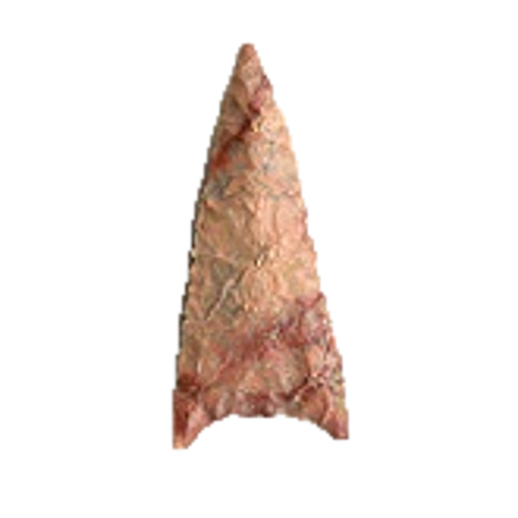
Arrowhead type
Maud Point
MaudLate Southern Triangle Cluster1,400 - 200 B.P.Mississippian15 reference photos
Key facts
- Age
- 1,400 - 200 B.P.
- Cultural period
- Mississippian
- Size
- Small
- Shape
- Triangle to Lanceolate
- Material
- Pottery
- Glacial period
- Medieval Warm to Little Ice Age
More from the Mississippian period
Description
This triangular point exhibits a slender profile, characterized by a narrow, flattened cross-sectional morphology. Its straight-edged blade assumes an isosceles triangular shape, where the width is approximately half the height. The blade edge may display fine serrations. The base of the point varies in curvature, ranging from a subtle concavity to a pronounced, V-shaped indentation, and often features basal thinning to enhance its overall morphology. The flaking pattern observed on this point is random, lacking a discernible, organized sequence.
Size
The dimensions of the arrowheads are characterized by a total length ranging from 19 to 55 mm, a width spanning 7 to 14 mm, and a basal concavity measuring between 3 to 7 mm, as outlined in the standards established by Suhm and Krieger (1954).
Distribution
This type is predominantly discovered in the Red River valley of northeast Texas, northeast Louisiana, southwest Arkansas, and southeast Oklahoma, typically in locales linked to the Caddoan tradition.
Additional information
In a notable distinction from Talco points, the arrowheads in question exhibit a more pronounced concavity at their base. Furthermore, the edges of these points are characterized by a straight profile, differing from the recurvate edges typically found on Talco points. This observation is supported by the research of Suhm and Krieger, who documented these characteristics in their 1954 publication. The presence of these distinctive features allows for a more precise classification and understanding of the technological and stylistic developments of the cultures that produced these arrowheads. By examining the specific attributes of these points, archaeologists can gain valuable insights into the lives and traditions of the people who crafted them, highlighting the importance of meticulous analysis in the field of archaeology.
Identified by
- Named by
- Dee Ann Suhm
- Year
- 1954
- Type site
- Multiple sites around Maud, Tx
Similar types
Types that are easy to confuse with the Maud point.
- Camp Creek
- McGloin
- Sand Mountain
- Starr
- Talco
- Tortugas
- Turney
- Zapata