
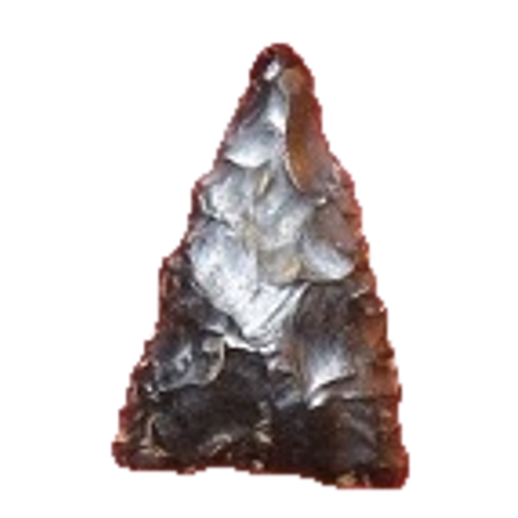
Arrowhead type
Madison Point
MadisonLate Woodland Triangle Cluster to Early Mississippian Triangle Cluster1,100 - 300 B.P.Late Woodland to Mississippian28 reference photos
Key facts
- Age
- 1,100 - 300 B.P.
- Cultural period
- Late Woodland to Mississippian
- Size
- Small to Medium
- Shape
- Triangle
- Material
- Jasper
- Glacial period
- Medieval Warm to Little Ice Age
More from the Woodland, Mississippian periods
Description
This triangular point exhibits a slender profile, measuring between 0.5 to 0.75 inches in thickness, with a cross-sectional shape that has been deliberately flattened. The blade's morphology is predominantly straight, although it can also display an excurvate or, more rarely, an incurvate curvature. In some instances, the blade edge may feature serrations. The point's overall shape typically conforms to an isosceles triangle, where the width is roughly half the height, or less commonly, an equilateral triangle, where the width and height are approximately equal. The base of the point is generally straight or slightly concave, often accompanied by basal thinning, which suggests a deliberate attempt to reduce weight and enhance balance. The flaking pattern observed on this point is characterized by a random arrangement of flakes. The manufacturing technique employed is pressure flaking, which can result in a wide range of quality, from finely crafted to relatively crude. Notably, re-sharpening is not a common feature of this point type, except in cases where the tip has been reworked.
Size
The dimensions of the arrowheads are as follows: they range in length from 13 to 55 mm, with a mean length of 26 mm. The width varies between 12 and 25 mm, while the thickness spans from 3 to 6 mm.
Distribution
This projectile is located from the Mississippi River to the eastern coastline. This projectile stretches into southern Ontario, and may stretch further into Canada.
Additional information
The distribution of this particular arrowhead point spans a broad geographic area, with its chronological context varying significantly depending on the location. Notably, in Florida and southern Georgia, small triangular points are specifically identified as Pinellas points. These points are believed to have superseded the Levanna point, marking a distinct shift in the region's lithic technology. Initially, Scully referred to this point as the Mississippi Triangular, but later introduced a new designation that gained popularity. However, earlier publications, such as Kneberg's 1956 work, continued to employ the terms Mississippi Triangular or Late Mississippi Triangular.
A crucial consideration in the identification of these points is the potential for confusion with unfinished preforms, which can be mistaken for other small arrow points, including the Madison point. To avoid this pitfall, archaeologists must carefully examine the edges of the points and preforms, paying close attention to the degree of alignment and any irregularities. As Morrow noted in 2016, this meticulous examination is essential for accurate identification, highlighting the importance of thorough analysis in distinguishing between finished points and unfinished preforms.
The Pinellas point's replacement of the Levanna point and its subsequent evolution underscore the dynamic nature of Native American lithic technology. The variation in dates across different geographic locations serves as a reminder of the complex and nuanced history of these artifacts. By recognizing the distinctive characteristics of the Pinellas point and exercising caution in its identification, researchers can continue to refine our understanding of the cultural and chronological contexts in which these points were crafted and utilized.
Identified by
- Named by
- Edward G Scully
- Year
- 1951
Similar types
Types that are easy to confuse with the Madison point.