
Arrowhead type
Sand Mountain Point
Sand MountainLate Woodland Triangle Cluster to Early Mississippian Triangle Cluster1,500 - 800 B.P.Late Woodland to MississippianKey facts
- Age
- 1,500 - 800 B.P.
- Cultural period
- Late Woodland to Mississippian
- Size
- Small
- Shape
- Triangle
- Glacial period
- Roman Warm to Medieval Warm
More from the Woodland, Mississippian periods
Description
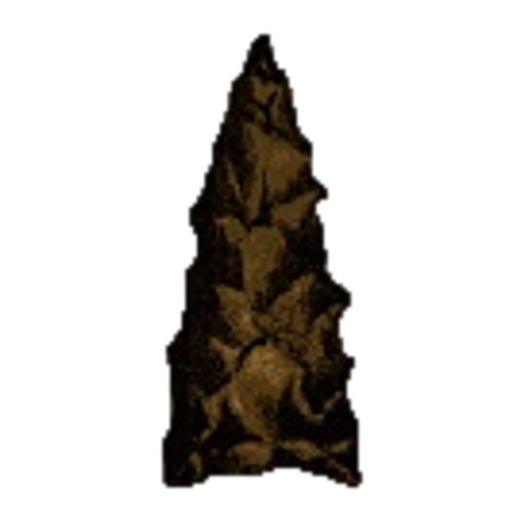
The artifact in question is a compact, triangular point, characterized by an elliptical profile. Its blade edge exhibits a range of curvature, from straight to subtly convex, and features pronounced serrations along its length. The basal margin is marked by a concave shape, accentuated by sharp, well-defined corners. The flaking pattern observed on this point is non-directional, lacking a discernible pattern or orientation, indicative of a random flaking technique.
Size
The arrowhead's dimensions are characterized by a total length ranging from 21 to 27 mm, with a mean length of 24 mm. The base width spans 13 to 15 mm, averaging 14 mm. In terms of thickness, the measurements vary from 3 to 7 mm. Additionally, the basal concavity is measured between 1 to 4 mm, with an average depth of 2 mm.
Distribution
This type is mainly located in upper Alabama and extends into Tennessee, Mississippi, and Georgia
Additional information
In the realm of Native American arrowhead typology, the Sand Mountain type is often compared to the Fort Ancient type due to their shared characteristics. However, a distinctive feature sets them apart: the base shape. Notably, the Fort Ancient type is defined by its straight base, whereas the Sand Mountain type exhibits a concave base. This subtle yet significant difference is a key diagnostic criterion for archaeologists seeking to identify and classify these artifacts. By examining the base morphology, researchers can accurately distinguish between these two types, ultimately contributing to a more nuanced understanding of the technological and cultural practices of the indigenous populations that created them.
Identified by
- Named by
- James Cambron and David Hulse
- Year
- 1975
Similar types
Types that are easy to confuse with the Sand Mountain point.
- Camp Creek
- Durant's Bend
- Fort Ancient
- Hamilton Triangle
- Madison