
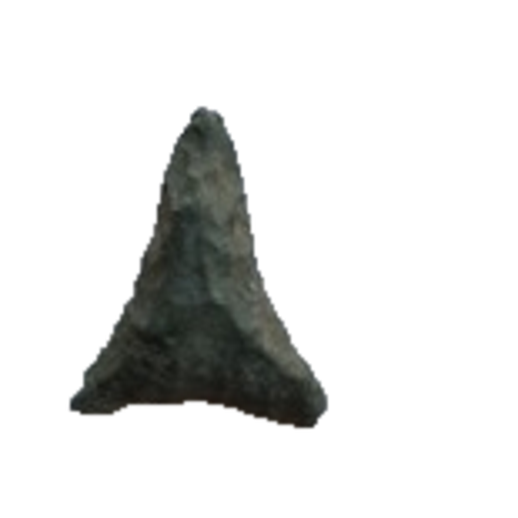
Arrowhead type
Uwharrie Point
UwharrieLate Woodland Triangle Cluster to Early Mississippian Triangle Cluster1,600 - 1,000 B.P.Woodland2 reference photos
Key facts
- Age
- 1,600 - 1,000 B.P.
- Cultural period
- Woodland
- Culture
- Uwharrie Culture
- Size
- Small
- Shape
- Triangle
- Glacial period
- Roman Warm to Vandal Minimum
More from the Woodland period
Description
This diminutive, triangular point exhibits a slender profile, characterized by a cross-sectional flattening. Its straight-edged blade assumes an isosceles triangular shape, where the width is roughly half the height. The basal margin varies in curvature, ranging from a subtle concavity to a more pronounced, deeply concave shape, and may feature basal thinning to enhance its overall morphology. The flaking pattern on this point appears to be random, lacking a discernible, organized sequence.
Size
The arrowheads exhibit a range of dimensions, with lengths spanning 18 to 45 mm, widths varying from 12 to 26 mm, and thicknesses measuring between 3 to 6 mm.
Distribution
This type is mainly located in the Piedmont region of Southern North Carolina and extending into South Carolina
Mainly found in
Additional information
In the realm of Native American arrowheads, a particular point of interest has been noted for its distinctive characteristics, often referred to in relation to the Hamilton Triangle. However, it is essential to clarify that the Hamilton Triangle is specifically associated with the Hamilton culture, which has a distinct geographical distribution that does not encompass the region in question. As a result, this particular point has been identified and classified separately, taking into account the cultural boundaries that define the archaeological context of the area. This separation is crucial for maintaining the accuracy and precision required in archaeological classification, ensuring that the unique attributes of this point are understood and appreciated within its correct cultural framework.
The distinction between this point and the Hamilton Triangle highlights the importance of considering cultural boundaries in archaeological analysis. By recognizing and respecting these boundaries, researchers can gain a deeper understanding of the historical and cultural significance of various artifacts, including arrowheads. This, in turn, allows for a more nuanced and accurate interpretation of the archaeological record, providing valuable insights into the lives and traditions of Native American communities. The separate identification of this point serves as a testament to the complexity and diversity of Native American cultures, underscoring the need for careful consideration and precise classification in archaeological research.
The cultural boundaries that define the context of this point are a critical aspect of its identification and classification. By examining the geographical distribution of the Hamilton culture and other relevant cultural groups, researchers can better understand the historical and cultural dynamics that shaped the development of various arrowhead styles. This point, in particular, offers a unique window into the cultural practices and traditions of the region, providing a valuable opportunity for further research and analysis. As such, its separate identification serves as an important reminder of the significance of cultural context in archaeological interpretation, highlighting the need for ongoing research and discovery in the field of Native American archaeology.
Identified by
- Named by
- Joffrey L Coe
- Year
- 1964
Similar types
Types that are easy to confuse with the Uwharrie point.