
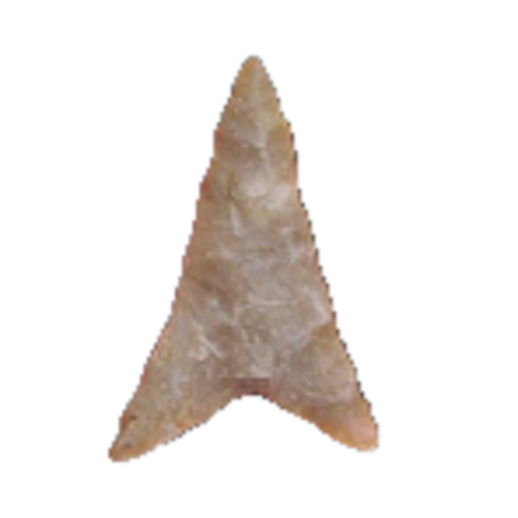
Arrowhead type
Starr Point
StarrLate Southern Triangle Cluster700 - 300 B.P.Late Prehistoric10 reference photos
Key facts
- Age
- 700 - 300 B.P.
- Cultural period
- Late Prehistoric
- Size
- Small
- Shape
- Triangle
- Material
- Pottery
- Glacial period
- Medieval Warm to Little Ice Age
More from the Late Prehistoric period
Description
This slender, triangular point exhibits a cross-sectional profile that ranges from flattened to elliptical in shape. The blade's longitudinal axis can be either straight or gently curved, displaying a subtle incurvation. A distinctive feature of this point is its base, which is characterized by a pronounced, V-shaped concavity. The manufacture of this point involved the application of fine pressure flaking, resulting in a flaking pattern that appears random and lacking in discernible order.
Size
The dimensions of these arrowheads are characterized by a total length ranging from 16 to 35 mm, with a mean length of 23 mm. The width varies between 10 and 29 mm, averaging 21 mm. In terms of thickness, the measurements fall within a range of 4 to 7 mm, with an average thickness of 5 mm, as documented by MacNeish in 1967.
Distribution
This type is mainly discovered in the southern Rio Grande Valley and along the adjacent shoreline. It is also identified in the Rio Grande valley and extending into northern Coahuila, Nuevo Leon, and Tamaulipas, albeit less commonly
Additional information
In the realm of Native American arrowhead typology, a distinct category of points has been identified, characterized by a base that ranges from straight to slightly concave, often accompanied by a smooth facial surface. These characteristics are reminiscent of Fresno points, a type that has garnered significant attention in archaeological circles. Notably, Davis (1995) has proposed that this particular point style may not be a discrete entity, but rather exists on a continuum with another well-documented type, the McGloin point. This perspective suggests that the distinctions between Fresno and McGloin points may be more nuanced than initially thought, highlighting the complexities and variations that exist within the broader context of Native American projectile point typology.
The observation that Fresno points may represent a continuum with McGloin points underscores the dynamic and evolving nature of archaeological classification systems. As our understanding of these ancient artifacts grows, so too do the subtleties of their categorization. The work of Davis (1995) serves as a testament to the ongoing refinement of our knowledge, as researchers continue to reexamine and reinterpret the existing data. By recognizing the potential continuum between Fresno and McGloin points, we are reminded of the importance of considering the broader cultural and historical contexts in which these points were created and utilized.
The characteristics of Fresno points, including their straight to slightly concave base and smooth facial surface, offer valuable insights into the technological and stylistic preferences of the Native American groups that crafted them. As archaeologists, the study of these points provides a unique window into the lives and traditions of these ancient cultures, highlighting the significance of continued research and analysis in this field. By exploring the nuances of point typology, we may uncover new patterns and relationships that shed further light on the complex and fascinating history of Native American cultures.
Identified by
- Named by
- Dee Ann Suhm
- Year
- 1954
- Type site
- Multiple sites in Starr County, Texas
Similar types
Types that are easy to confuse with the Starr point.