
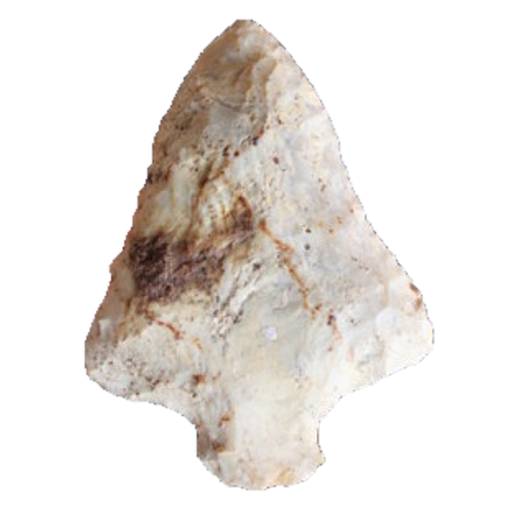
Arrowhead type
Elora Point
EloraLedbetter Stemmed Cluster4,800 - 4,300 B.P.Late Archaic23 reference photos
Key facts
- Age
- 4,800 - 4,300 B.P.
- Cultural period
- Late Archaic
- Size
- Medium to Large
- Shape
- Straight Stem to Contracting Stem
- Glacial period
- Middle Holocene to Neoglacial
More from the Archaic period
Description
This triangular stemmed point exhibits a size range of 1.75 to 3.75 inches, characterized by a thick elliptical cross-section. The blade typically presents a straight profile, occasionally featuring fine serrations, and may display a subtle curvature, ranging from slightly excurvate to slightly incurvate. The shoulders often exhibit a degree of asymmetry, with one shoulder positioned slightly higher and having a narrower stem-blade junction, while the other shoulder sits lower with a wider junction, and one shoulder tends to be sharper than the other. The shoulders are generally oriented horizontally, although some specimens may display an upward angle or a slightly barbed configuration. The stem can vary from straight to slightly contracting, and the base is often straight, but may be slightly convex. Notably, many examples of this point type have stems that appear unfinished or are broken off. The flaking pattern on this point is characterized as random.
Size
The dimensions of the arrowheads are as follows: they range in overall length from 39 to 81 mm, with a typical length of 53 to 63 mm. The stem portion measures between 5 and 17 mm in length, averaging 6 to 12 mm. In terms of width, the blade spans 31 to 57 mm, with an average width of 37 to 43 mm. The stem width varies from 15 to 22 mm, typically falling within the range of 16 to 20 mm. The thickness of the arrowheads ranges from 7 to 12 mm.
Distribution
This type is mainly discovered ranging from the Tennessee River Valley of southern Tennessee into northern Florida and western South Carolina.
Mainly found in
Also found, less often, in
Additional information
In the realm of Native American archaeology, the Elora Serrated point has been identified as a potential variant of the Elora point, as noted by Hulse in 1975. A key characteristic that distinguishes this type is the presence of serrations along the entire length of the blade, which sets it apart from similar point types. Notably, the South Prong Creek type, while sharing similarities with the Elora Serrated point, can be differentiated by the limited extent of its serrations, which typically cover only about two-thirds of the blade, as observed by Schroder in 2011.
The distinction between these point types is significant, as it highlights the nuances of technological and stylistic variations among Native American cultures. The Elora Serrated point's distinctive serrations, which span the entire blade, may indicate a specific functional or cultural purpose, warranting further investigation. In contrast, the South Prong Creek type's more limited serrations may suggest a different set of priorities or influences in its design.
The study of these point types, including the Elora Serrated and South Prong Creek, contributes to a deeper understanding of the complexities and diversities of Native American cultures, particularly in terms of their technological and artistic expressions. By examining the subtle differences between these point types, researchers can gain insights into the cultural, social, and environmental contexts in which they were created, ultimately enriching our knowledge of the rich and varied heritage of Native American communities.
Identified by
- Named by
- James Cambron and David Hulse
- Year
- 1960
Similar types
Types that are easy to confuse with the Elora point.
- Abbey
- Bradford
- Broward
- Cotaco Creek
- Cottonbridge
- Levy
- Marion
- Morrow Mountain Straight Base
- Mulberry Creek
- Rheems Creek
- Weeden Island