
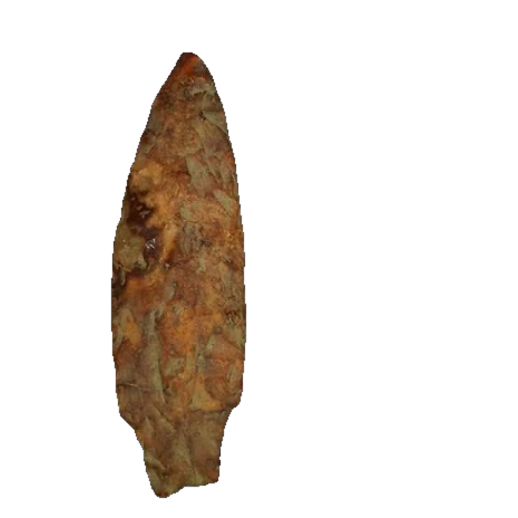
Arrowhead type
Thonotosassa Point
ThonotosassaLedbetter Stemmed Cluster7,000 - 5,500 B.P.Middle Archaic28 reference photos
Key facts
- Age
- 7,000 - 5,500 B.P.
- Cultural period
- Middle Archaic
- Culture
- Phase:
- Size
- Large
- Shape
- Straight Stem to Contracting Stem
- Material
- Ceramic
- Glacial period
- Middle Holocene
More from the Archaic period
Description
This lanceolate point exhibits a distinctive morphology, characterized by a substantial length and thickness, typically measuring between 3.5 to 6 inches. Its cross-sectional profile is elliptical, and in some instances, a median ridge is present on one of its faces. The blade's curvature is predominantly excurvate, while the shoulders display a range of orientations, from horizontal to upwardly angled. Notably, the shoulders are often asymmetrical and weakly defined, with one shoulder sloping upward and the other remaining horizontal. The stem's configuration can vary, ranging from straight to contracting, with a base that may be straight or convex. The flaking pattern observed on this point is random, lacking a consistent or organized arrangement.
Size
The dimensions of the arrowheads are as follows: they range in overall length from 85 to 160 mm, with stem lengths varying between 10 and 20 mm. The width of the blade spans from 30 to 53 mm, while the thickness measures between 10 and 15 mm.
Distribution
This type is mainly discovered in the Tampa area and throughout middle Florida.
Mainly found in
Additional information
In the realm of Native American arrowhead typology, a particular point style has garnered significant attention from archaeologists. Initially, Gray (1975) introduced the "Palm River" point, but subsequent research has led to the conclusion that its characteristics are, in fact, indistinguishable from those of another established type, rendering it unnecessary to categorize it as a distinct entity. A more nuanced understanding of this point style was provided by Bullen (1975), who identified four subtypes based on variations in stem and base morphology.
A closer examination of these subtypes reveals notable differences in their basal configurations. Subtype 1 is characterized by a contracting stem that terminates in a convex base, while Subtype 2 exhibits a similar contracting stem but with a flat base. In contrast, Subtype 3 features a contracting stem with a concave base, highlighting the diversity within this point style. The fourth subtype is distinguished by its broad, square base, which sets it apart from the other three subtypes. These subtle yet significant variations underscore the complexity and sophistication of Native American arrowhead craftsmanship.
The identification of these four subtypes not only refines our understanding of this particular point style but also underscores the importance of meticulous typological analysis in archaeology. By recognizing and categorizing these subtle differences, researchers can gain valuable insights into the technological, cultural, and historical contexts in which these arrowheads were created and used. As such, the study of Native American arrowheads continues to be an essential aspect of archaeological inquiry, offering a unique window into the lives and traditions of indigenous cultures in North America.
Identified by
- Named by
- Lyman Warren and Ripley P. Bullen
- Year
- 1971
- Type site
- Fletcher Davis (8HI106) site, Hillsborough County, Florida
Similar types
Types that are easy to confuse with the Thonotosassa point.
- Cypress
- Hardee
- Hillsborough
- Newnan
- Pasco Knife